Gresham College provides outstanding educational talks and videos for the public free of charge. There are over 2,500 videos available on our website. Your support will help us to encourage people's love of learning for many years to come.
Even the most humdrum of electrical devices nowadays contains at least one computer; yet surprisingly few people are aware of their history, their form or function. In this talk we will see that not only is the history of computers rich and diverse, their architecture likewise.
Niklaus Wirth said Algorithms + Data Structures = Programs. But programs are more than that. They are ubiquitous in modern life, but only a tiny minority of the population know how to program.
Scriabin was Rachmaninov’s classmate at the Moscow Conservatoire, and enjoyed comparable fame during his lifetime, and yet today he is much less known, especially outside Russia.
Humans use computers to do gigantic calculations which would be impossible to do by hand – for example, weather prediction. But could an AI go beyond that and come up with a proof of a theorem which has stumped humankind?
This lecture will look at change ringing, which is ringing a series of tuned bells (as you might find in the bell tower of a church) in a particular sequence, and this has exciting mathematical properties. We will also ask: why are bells bell-shaped?
Boris Ord composed one tiny Christmas carol – ‘Adam lay ybounden’. But Ord’s largest contribution to the carol genre was his work as choirmaster at King’s College, Cambridge from 1929 to 1957.
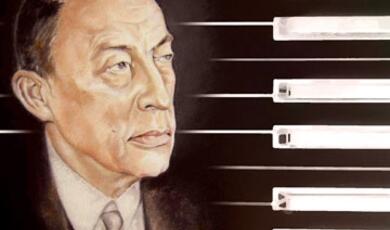
Rachmaninov is considered by many to be the greatest composer-pianist in history. But his very popularity has left the complexity and subtlety of his music underappreciated.
It has been known since antiquity that there are simple “harmonic” relationships between notes that sound appealing together. This lecture introduces the mathematics of pitch, scales, and just temperament. The pitch of a sound is not its only important property.