Gresham College provides outstanding educational talks and videos for the public free of charge. There are over 2,500 videos available on our website. Your support will help us to encourage people's love of learning for many years to come.
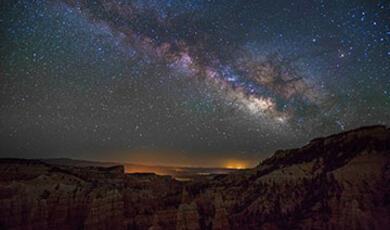
What did the sky-watchers of the ancient world think about the night sky, and its implications for human existence? Moving on to the great discoveries of Copernicus, Kepler, and Galileo, we will consider the basic science and ask about the deeper significance of these discoveries.
Productivity growth in the UK economy has lagged behind that of our major trading partners. We will examine a number of possible explanations ranging from the role of finance to the employment of physical and human capital.
An exploration of a time when there were no stars or galaxies, and the universe was transparent - how were the first indications of the state of the universe in the dark ages discovered?
Professor Silk will explore the origin of this paradigm shift in our cosmic horizon, and discuss the origin of the acceleration as a phenomenon that we call dark energy.
Can a scientific theory ever be confirmed? Must a scientific theory be falsifiable? Theories such as that of the multiverse and string theory will be considered.
In the first three minutes after the beginning of the universe, all of the stuff that we and the Earth are made of were created and the universe attained its huge size, homogeneity and isotropy.
Amongst all his astronomical allusions, Shakespeare demonstrates a deep knowledge of the night sky and its movements, including the new Copernican world-view. What can we learn of Elizabethan astronomy and Shakespeare's knowledge of it from the plays?