Gresham College provides outstanding educational talks and videos for the public free of charge. There are over 2,500 videos available on our website. Your support will help us to encourage people's love of learning for many years to come.
In 1930, the great physicist Wolfgang Pauli invented a new particle to save the principle of energy conservation in certain radioactive decays he was studying.
Amelia Dyer was one of the most prolific murderers in Victorian Britain. She made a living as a “baby farmer”, or someone paid to care for unwanted or abandoned infants – except she killed around 400 of them. How could a mother and nurse murder so many defenceless babies?
Over the last 30 years, digital technology produced an exponential increase in astronomical data. Within our lifetime, the entirety of the visible universe will have been mapped out: we will have seen everything there is to see. The question will then be: what does it all mean?
Accounts of occasional celestial spectacular events in past centuries have provided crucial information for modern-day astrophysicists. One such example is the so-called Great Eruption of Eta Carinae which was for a time in the mid 19th century the third brightest object in the night sky.
Well-trained eyes can be remarkably useful for capturing light curves of evolving objects in the cosmos, even contributing to modern research programmes.
This lecture examines the centuries long presence of the African diaspora as an integral part of Britain’s history since Roman times. Unfortunately, this history is still too often ignored, its promotion limited only to October.
Eve was the original Evil Woman. She was tempted by Satan, introducing sin into the world. In turn, she seduced Adam, bringing the wrath of the Creator upon humanity for all eternity.
At longer wavelengths than the normal optical wavelengths to which human eyes are normally sensitive, is the radio part of the electromagnetic spectrum.
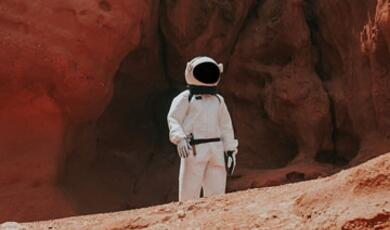
Mars has changed since it formed 4.6 billion years ago. When life started on Earth ~4 billion years ago, Mars was habitable too, with volcanism, a magnetic field, surface water and a thick atmosphere. Today, Mars is cold and dry, with a thin atmosphere and harsh surface.

This talk will consider how expectation plays a role in discovery and in scientific advance, and considers the challenges involved in assessing changes taking place on our own planet.