Gresham College provides outstanding educational talks and videos for the public free of charge. There are over 2,500 videos available on our website. Your support will help us to encourage people's love of learning for many years to come.
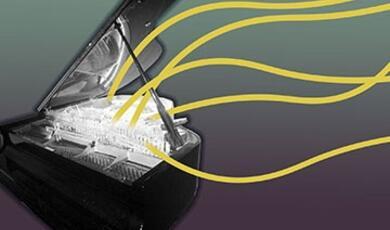
The Magnetic Resonator Piano invented by Andrew McPherson sees electromagnets suspended above the strings of a regular grand piano, allowing for control of minute details of shimmering resonance.
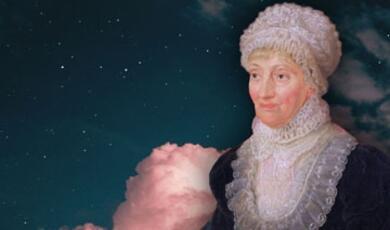
In this talk Dr Sheila Kanani combines the story of a pioneering woman astronomer, with an account of the science behind comets, asteroids and meteors.
When black holes merge, the world shakes. Such quakes in space-time are now detectable and indeed the detection of such gravitational waves from cosmic coalescences comprises an entirely new type of astronomy that is completely independent of light itself.

Could AI replace stand-up comedians and scriptwriters? This may not be an impossible dream if you accept that nothing we do is forever beyond the scope of computer modelling.
Space today is terrifyingly silent. But it wasn’t always thus: the early universe was filled with a hot plasma in which sound waves could travel. The cosmos was quivering with the aftershocks of the Big Bang.
On 17 August 1982, the first commercial CD was released. Digital recording and editing have changed the face of music by making recordings easy to originate and share. But has this affected musical quality, and what are the financial and artistic consequences?
Highly energetic particles from outer space travelling at the speed of light, known as cosmic rays, originate from the sites of extreme particle acceleration in the Universe.
When light is dispersed into its constituent colours, it can become possible to discern rich dynamical information about an evolving system in space, for example cosmic explosions, collisions or accelerations.
In 1930, the great physicist Wolfgang Pauli invented a new particle to save the principle of energy conservation in certain radioactive decays he was studying.