Gresham College provides outstanding educational talks and videos for the public free of charge. There are over 2,500 videos available on our website. Your support will help us to encourage people's love of learning for many years to come.
Matter consists of a mêlée of elementary particles. There are protons and neutrons, made up of quarks, and many other short-lived massive particles. One hope is to discover particles of dark matter, but this has so far eluded our best efforts.
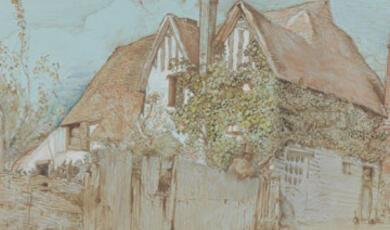
Samuel Palmer, in his Shoreham period in the 1820s and 30s, seized on the long tradition of classical pastoral landscapes, and wrested it into an English idiom.
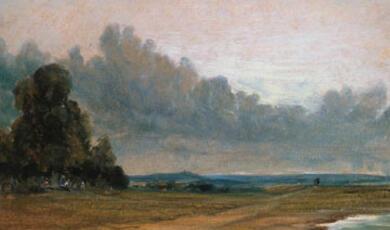
Constable's Stour landscapes of the Regency period, during and just after the War with France, and his publication English Landscape Scenery, champion local and low-key rural England.
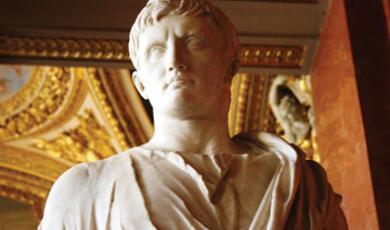
Mary Beard, Professor of Classics at the Univeristy of Cambridge, Fellow of Newnham College, and Royal Academy of Arts Professor of Ancient Literature - who is also well-known for her media appearances - will speak on the fascinating topic of images of Roman Emperors.
What happens when power, communications, and transport are all disrupted, when shops cannot function, and when most people cannot find out what is happening? Storm Desmond in 2015 revealed how dependent on electricity modern city life has become. What lessons have been learnt?

A celebration of the heart for St Valentine’s Day. How is it that a simple pump has become a symbol of the highest human emotions of love, truth, conscience and moral courage? How have artists represented this? An interdisciplinary presentation.
Can a scientific theory ever be confirmed? Must a scientific theory be falsifiable? Theories such as that of the multiverse and string theory will be considered.
In the first three minutes after the beginning of the universe, all of the stuff that we and the Earth are made of were created and the universe attained its huge size, homogeneity and isotropy.
Examples of disease as shown in artworks will be examined, from the medical and surgical point of view as well as the historical and artistic ones, particularly visual loss as portrayed by artists from pre-historic times.