
 Login
Login

The Myth and Promise of the U.K. Jury Trial

Share

- Details
- Text
- Audio
- Downloads
- Extra Reading
The Lammy plan to eliminate half of U.K. criminal jury trials has provoked a rebellion among many lawmakers. Recent Palestine Action cases highlight the jury’s moral role, with several “perverse verdicts” acquitting activists despite clear evidence. Yet those charged with the lesser offence of “supporting” PA have been denied a jury trial and the chance of acquittal.
Compared with U.S. constitutional protections, including impartial juries, vicinage rules, challenges to biased pools, and post‑trial juror inquiry—the U.K. system appears increasingly problematic. In this lecture, Professor Clive Stafford Smith makes the case for stronger jury protections.
Download Text

Lecture 1: The myth and promise of the U.K. jury trial
Professor Clive A. Stafford Smith
17th September 2026
David Lammy’s proposals to do away with roughly half the criminal jury trials in the U.K. have provoked a minor rebellion among lawmakers in Britain. At the same time the legal profession is responding to a challenge from some in the judiciary, where the supposed “perverse verdict” (more favourably known as “the jury nullification prerogative” or the “prerogative of mercy” in the U.S.) is under threat.[1]
When it comes to crises, both of these are what former U.S. Defense Secretary Donald Rumsfeld would have labelled “known knowns”. At the same time, when it comes to the jury, there are other issues that are seemingly “unknown unknowns” that are intentionally kept opaque that pose and equal, or greater, challenge to the justice system. At the lecture I hope to deal with both
The Historical Right to a Jury
Like many hallowed rights, the history of the jury trial is not entirely rose-tinted vision that many think. To be sure the trial by jury has been an established right in England since 1215 and the signing of Magna Carta:
no free man shall be seized or imprisoned, or stripped of his rights or possessions, or outlawed or exiled, or deprived of his standing in any way, nor will we proceed with force against him, or send others to do so, except by the lawful judgment of his equals or by the law of the land.
Yet like so many things, this was a “right” only for the few. First, it was limited on its face to “free men”, which eliminated women and most men (it was not meant for serfs). But more than this, the jury was actually less of a beacon of liberty in its early days, and more a method of control.
My student Shara traced the history of the jury trial in class, and here I will borrow liberally from her research. In Anglo-Saxon England, she wrote, under Æthelred the Unready (c. 997), the “gemot”[2] required twelve thegns and a reeve to swear an oath not to accuse the innocent nor conceal the guilty. This mechanism was not really a forum for adjudication – more a tool of communal regulation, reflecting collective responsibility rather than individual rights.
Following the Norman Conquest, this embryonic jury was further incorporated by the Crown as part of the Royal inquest, most notably those underpinning the Domesday survey. This was aimed to help with administrative efficiency and fiscal control rather than protect the rights of individuals. A criminal process was formalised under Henry II through the Constitutions of Clarendon,[3] which employed sworn local jurors to present suspected criminals. Again this entrenched the jury as an arm of royal governance - effectively an accusatory body akin to the later grand jury – rather than an individual protection. The jury was then extended into civil litigation, through actions such as mort d’ancestor[4] whichallowed for the rapid resolution of any land dispute – again a procedural tool for those in power.
Initially, juries operated as bodies of local men reporting wrongdoing to royal officials. Over time, the accusatory (Grand Jury) role was supplemented, as “petty (petit) juries” were tasked with deciding guilt based on local knowledge. However, the Statute of Westminster enforced participation through the threat of peine forte et dure, whereby defendants who refused to submit to jury trial were subjected to various coercions, ranging from pressing with ever greater weights of stone, to simple starvation, both ending in death. Where the accused felt (realistically) that conviction was essentially certain, he might endure fatal peine forte et dure so as to protect his heirs from losing the estate to forfeiture.
Meanwhile the law developed so that if the jury did not reach the “correct” verdict, they could themselves face prosecution for perjury. Again, the jury trial was not valued as a safeguard so much as an efficient means of securing convictions. For a long time, this remained part of the Crown’s broader project of legal centralisation.
The path between the abolition of peine forte et dure[5] in 1772 and the abolition of the grand jury by the Administration of Justice (Miscellaneous Provisions) Act 1933 (which dismantled its accusatory function altogether) stand as illustrations of the jury’s vulnerability to an “evolution” that could be either positive or, in the case of David Lammy’s proposals, rather devastating.
As late as the Criminal Justice Act 1855, individuals charged with larceny choice between summary and jury trial, but with in-built bias against the jury trial: those opting for summary trial avoided forfeiture, whereas defendants convicted of the same offence by jury faced loss of their property.[6] This penalty upon a right would be patently unconstitutional in the U.S. However, by maintaining such harsh controls the state did not reduce the risk of false convictions, but rather maximised the likelihood of conviction and confiscation of property.
Bushell’s Case (1670)
If the evolution of the jury was not a smooth and consistent one, Bushell’s case was one step that set a vital precedent.[7] The link to the U.S. is rather clear. The case involved two “Dissenting” Quakers who were patently “guilty”, on the face of the clear evidence; one was William Penn, the future founder of Pennsylvania, and the other was William Mead. They had been arrested in August 1670 for violating the Conventicle Act, which forbade religious assemblies of more than five people outside the auspices of the Church of England.
If they had clearly violated the law, the ultimate issue was whether the law was just. Initially a rebellious jury found the two "guilty of speaking in Gracechurch Street" but refused to find "an unlawful assembly". The judge was furious and admonished the jury:
‘Gentlemen, You shall not be dismissed till we have a verdict that the court will accept; and you shall be locked up, without meat, drink, fire, and tobacco; you shall not think thus to abuse the court; we will have a verdict, by the help of God, or you shall starve for it’ [8].
The jury came back a second time, "guilty of speaking to an assembly in Gracechurch Street" but again refusing to find the assembly "unlawful".
At one point before the judge thought to have Penn bound and gagged he shouted to the jury, "You are Englishmen, mind your Privilege, give not away your Right!" The foreman of the jury Edward Bushel replied, "Nor shall we ever do." Finally, after a two-day fast in the Tower of London, the jurors returned a verdict of “not guilty”. The judge fined the jury for contempt of court for returning a verdict contrary to their own findings of fact and removed them to prison until the fine was paid. Penn protested that this violated the Magna Carta and was removed from the court.
Some paid the fine, but Edward Bushell refused to pay the fine and was ultimately released through a writ of habeas corpus. It was no simple victory (initially Bushell lost), but eventually Chief Justice John Vaughan ruled that it “is absurd to fine a jury for finding against their evidence”, concluding that Bushel and his fellow jurors had the right to acquit based regardless of the trial judge’s view.[9]
The case held:
‘A man cannot see by another's eye, nor hear by another's ear, no more can a man conclude or infer the thing to be resolv’d by another's understanding or reasoning’.[10]
Because the case is seen as the affirmation of the jury’s right to do justice, not merely convict, it is commemorated in a plaque at the Royal Courts of Justice on the left hand side of the great entrance hall, past which anyone entering must walk. The inscription reads as follows:
Near this site William Penn and William Mead were tried in 1670 for preaching to an unlawful assembly by Grace Church Street. [With] courage and endurance of Jury Thos Vere, Edward Bushell and ten others … refused to give a verdict against them, although locked up without food for two nights and … fined for their final Verdict of Not Guilty. The case of these Jurymen was reviewed on a Writ of Habeas Corpus and Chief Justice Vaughan delivered the opinion of the Court which established the right of juries to give their verdict according to their Convictions.
The rule of Bushell’s Case is that jurors are never required to convict, no matter what the evidence, if they individually think it would do an injustice to do so. Neither can the decision of a jury be appealed and a verdict of acquittal overturned. This is the essential feature of individual human rights: that the individual is protected from overreaching by the all-powerful government by the common sense of the jury.
Bushell’s Case was the Backdrop to U.S. Constitutional rights
It was not a long time in historical terms between 1670 and the Revolution in 1776 and there had been plenty of mischief in between. Grievance 18 out of 27 in the Declaration of Independence complained that George III had “depriv[ed] us in many cases, of the benefit of trial by jury.” As history records in such cases as the famous Boston Tea Party, there was plenty of taxation without so much representation. Meanwhile, an act had been passed that placed violations of the revenue laws under the jurisdiction of the admiralty courts, where the offenders were tried, but the prosecutors were biased towards the crown.
Grievance 19 was that he had “transport[ed] us beyond Seas to be tried for pretended offenses." On the fifteenth of April, 1774, Lord North introduced a bill " for the impartial administration of justice in the cases of persons questioned for any acts done by them in the execution of the laws, or for the suppression of riots and tumults in the province of Massachusetts Bay, in New England."
"We must show the Americans," he argued, "that we will no longer sit quietly under their insults; and also, that even when roused, our measures are not cruel or vindictive, but necessary and efficacious." The bill provided that “it shall and may be lawful for the governor, or lieutenant-governor, to direct, with the advice and consent of the council, that the inquisition, indictment, or appeal, shall be tried in some other of his Majesty's colonies, or Great Britain.”
When they had thrown these shackles off, the newly minted U.S. Constitution preserved the right to a jury trial in various ways. Article III, Section 2, Clause 3 of the Constitution itself made clear that
“[t]he Trial of all Crimes, except in Cases of Impeachment, shall be by Jury; and such Trial shall be held in the State where the said Crimes shall have been committed…”
Later, when the Bill of Rights was added, in addition to preserving the right to remain silent, the Fifth Amendment enshrined the right to a grand jury:
“No person shall be held to answer for a capital, or otherwise infamous crime, unless on a presentment or indictment of a Grand Jury…”
The Sixth Amendment was the main protector of the criminal jury:
“In all criminal prosecutions, the accused shall enjoy the right to a speedy and public trial, by an impartial jury of the State and district wherein the crime shall have been committed, which district shall have been previously ascertained by law…”
The Seventh Amendment extended a similar right in civil cases:
“In Suits at common law, where the value in controversy shall exceed twenty dollars, the right of trial by jury shall be preserved, and no fact tried by a jury, shall be otherwise re-examined in any Court of the United States, than according to the rules of the common law.”
When it comes to the application of Bushell’s Case, the U.S. Courts have directly considered whether it right to dismiss a juror whose agenda was allegedly to acquit by nullifying the law, regardless of any facts.[11] ‘Juror No. 5’ was the only black juror hearing the case of all-black defendants, with his fellow jurors reported that he had a “predisposed disposition”, and that he was resolved on acquittal because the defendants were “his people”. The District Court applied Fed. R. Crim. P. 23(b),[12] allowing the dismissal Juror No. 5 for a ‘just cause’. The Second Circuit was reluctant to encourage jury nullification or to label it as a ‘right’. They did, however, cite Bushel’s case for the proposition that nullification of an unjust application of the law is an intrinsic power of a juror.[13]
This case places this power as part of the right to an impartial jury. Judge Jack Weinstein has written that “when jurors return with a ‘nullification’ verdict, then, they have not in reality ‘nullified’ anything: they have done their job”[14].
The Supreme Court in Taylor v Louisiana described the jury’s function to be to “guard against the exercise of arbitrary power—to make available the commonsense judgment of the community as a hedge against the overzealous prosecutor and in preference to the professional or perhaps overconditioned or biased response of a judge.”[15] The jury’s independence – and their ‘power’ to nullify the law – are key to their function in upholding fairness in the justice system.
Far from allowing the abolition of the jury trial in the manner of David Lammy’s proposals, the U.S. Supreme Court – often lambasted for being right wing – has strongly defended the role of the jury. They have recently turned back laws that allowed a non-unanimous verdict. Ramos v. Louisiana, 590 U.S. 83 (2020). In the series of cases emanating from Apprendi v. New Jersey, 530 U.S. 466 (2000), the Court has preserved the jury’s role further perhaps than anyone would have thought possible in 1789 by mandating that juries should make factual findings that relate to the quantum of punishment.
The U.S. system also includes clear protections to make sure that a jury is genuinely representative of the community, as well as being genuinely unbiased. The constitution makes clear where the trial should be – the venue where the crime is alleged to have been committed. Hence there can be no decision by the government to choose a more favourable place.
However, sometimes the constitutionally identified venue is itself not likely to allow for a fair jury. Then the next step is the motion for a change of venue, which aims to prevent a trial from taking place where the jurors are biased even before the case begins. In Sheppard v. Maxwell, 384 U.S. 333, 363 (1966), the United States Supreme Court held that, "where there is a reasonable likelihood that prejudicial news prior to the trial will prevent a fair trial, the judge should continue the case until the threat abates, or transfer it to another county not so permeated with publicity." Failing to grant a change of venue can result in reversal: "Prejudice is presumed from pretrial publicity when (1) pretrial publicity is sufficiently prejudicial and inflammatory, and (2) the prejudicial pretrial publicity saturated the community where the trials were held."[16]
Next comes the jury composition challenge, where the jury pool in the chosen venue may be unrepresentative of the community at large. This may come about due to a law that excludes certain people from participating on the jury. A century and a half ago, in Strauder v West Virginia, the Supreme Court held that a state law that excluded citizens from participating in a jury because of their race violated the Equal Protection Clause of the Fourteenth Amendment.[17] The case involved an African American defendant accused of murdering his wife, and the Court asked how could a jury be ‘drawn from a panel from which the State has expressly excluded every man of his race, because of color alone.’[18]
Women faced a similar prejudice – they were meant to be in the home, or they were to be “protected” from the harsh realities of crime. The Court addressed gender discrimination in Taylor v Louisiana, where the court held that the exclusion of women from jury pools violated the defendant’s Sixth Amendment right to a jury drawn from a ‘fair cross-section of the community.’[19] By making women’s participation optional, in other words allowing women to exempt themselves from the jury, Louisiana failed to create a system in which juries represented a reasonably accurate representation of the community, undermining the constitutional meaning of impartiality.[20]
But it may not be a simple law that taints the jury venire. As often as not now it is the manner in which they jury list is compiled, normally by jury commissioners. The most important part of this is that the jury lists must be a public record – how else can litigants be sure that someone (normally the government) is not rigging the selection process? Then it is up to a suspicious lawyer to look into a pool that appears not to be representative.
Under the Sixth Amendment fair cross section approach, a prima facie case of discrimination in the jury composition requires proof "(1) that the group alleged to be excluded is a 'distinctive' group in the community; (2) that the representation of this group in venires from which juries are selected is not fair and reasonable in relation to the number of such persons in the community; and (3) that this underrepresentation is due to systematic exclusion of the group in the jury selection process."[21] Proof offered of a denial of equal protection may be rebutted by the State only by proving an absence of discriminatory intent.[22] However, where a large disparity is shown to have existed over a long period of time, self-serving testimony of jury commissioners that they did not discriminate in the selection of the jury pools has repeatedly been held insufficient to overcome the prima facie case.[23]
This may all sound complicated, but it actually is not. It is a truly vital check on what may seem to be governmental abuse – as we will see when looking at the British practice even today.
The next phase in ensuring that jurors are impartial is voir dire – the process of asking jurors what they really think. For any lawyers who really understand the process, this is also the opportunity to learn how the juror thinks too. Yet the simple issues are ultimately these – how can one speak to jurors persuasively if one does not understand what they fundamentally believe? And can one actually expect jurors all to be unbiased, especially in particularly emotional cases?
In State v. Lee, 559 So. 2d 1310 (La. 1990), the court described the right as follows:
a criminal defendant is constitutionally entitled to conduct a full and complete examination of prospective jurors on voir dire. This right provides the defendant the opportunity to excuse jurors for cause, and also gives the defendant the opportunity to intelligently exercise peremptory challenges. Defense counsel should be given 'wide latitude' during voir dire . . . to explore the attitudes and experiences of the prospective jurors.[24]
Likewise, though, the abuse of challenges to jurors could result in a biased panel. This can come either through challenges for cause (where there is an assumption the juror actually is biased) as well as peremptory challenges (where the parties are allowed to strike jurors who do not meet the cause threshold). While such challenges are important to ensure a fair jury,[25] they can be abused. Drawing from the race-based precedent set in Batson v. Kentucky,[26] in J.E.B. v Alabama ex rel T.B., the court held that to exercise peremptory challenges based on a prospective juror’s gender is unconstitutional.[27] The case involved child support, and the prosecution struck male jurors from the panel, resulting in an all-female jury judging an allegedly delinquent father.
In the end there are two principles that guide the U.S. Constitutional right to a jury trial: first, that it must be protected at all costs, since it has evolved into a great bulwark against government oppression, most needed when – as increasingly in the U.S itself – the government seems dead set on oppressing certain people. But second, that great effort should go into making sure that those who sit on the jury are truly unbiased.
Official Discomfort with Jury Nullification in the U.K.
The same cannot be said in the U.K. If Bushell’s Case established the jury’s absolute right to acquit according to their sense of justice, judges have not always been comfortable with it. There are those in the judiciary who strongly dislike the notion. This is perhaps rooted in the British judiciary’s notion that, to be fair, judicial decisions my always be seen to be “objective” – if the law states that X is illegal, and if the defendant did X, then the legal system must reach the objective determination that X is guilty.
To be sure there are those in the U.K. who would not take this view; it is anathema to U.S. lawyers. Whereas in the U.K. a barrister’s first duty is often said to be to the Court, and to the concept of justice, in the U.S. the advocate’s first duty is to the client.[28] This shapes decisions in important ways.
For a long time, when it came to the issue in Bushell’s Case, the courts generally took a similar position in both the U.K. and the U.S. Whether a right or a power, the fundamental ability for the jury to acquit was seen as a “guard[] against arbitrary power” enforced by the “commonsense judgements of the community.” This was recently in play in Bristol in the case of the Colston Four.[29] On 7th June 2020, some Black Lives Matter (BLM) protesters tore down a statue of Edward Colston, a slave trader from Bristol and threw it into the floating harbour due to his historical role in black oppression. Four protestors were arrested for their roles and charged under the Section 1 Criminal Damage Act 1971.[30] In court, the defence focused on justifying the protestor’s actions rather than denying the actions themselves. The defence argued whilst the protestors did cause criminal damage, they had a ‘legal excuse’ to do so,[31] because the statute was “offensive to the true character of Bristol.” The Conversation said “it was Edward Colston and Bristol City Council that appeared to be on trial.”[32] The jury’s reasoning is always secret in the U.K. (for reasons that are themselves suspect) but they acquitted and clearly, as was said in Taylor, the jury has a role to “make commonsense judgement[s] of the community.”
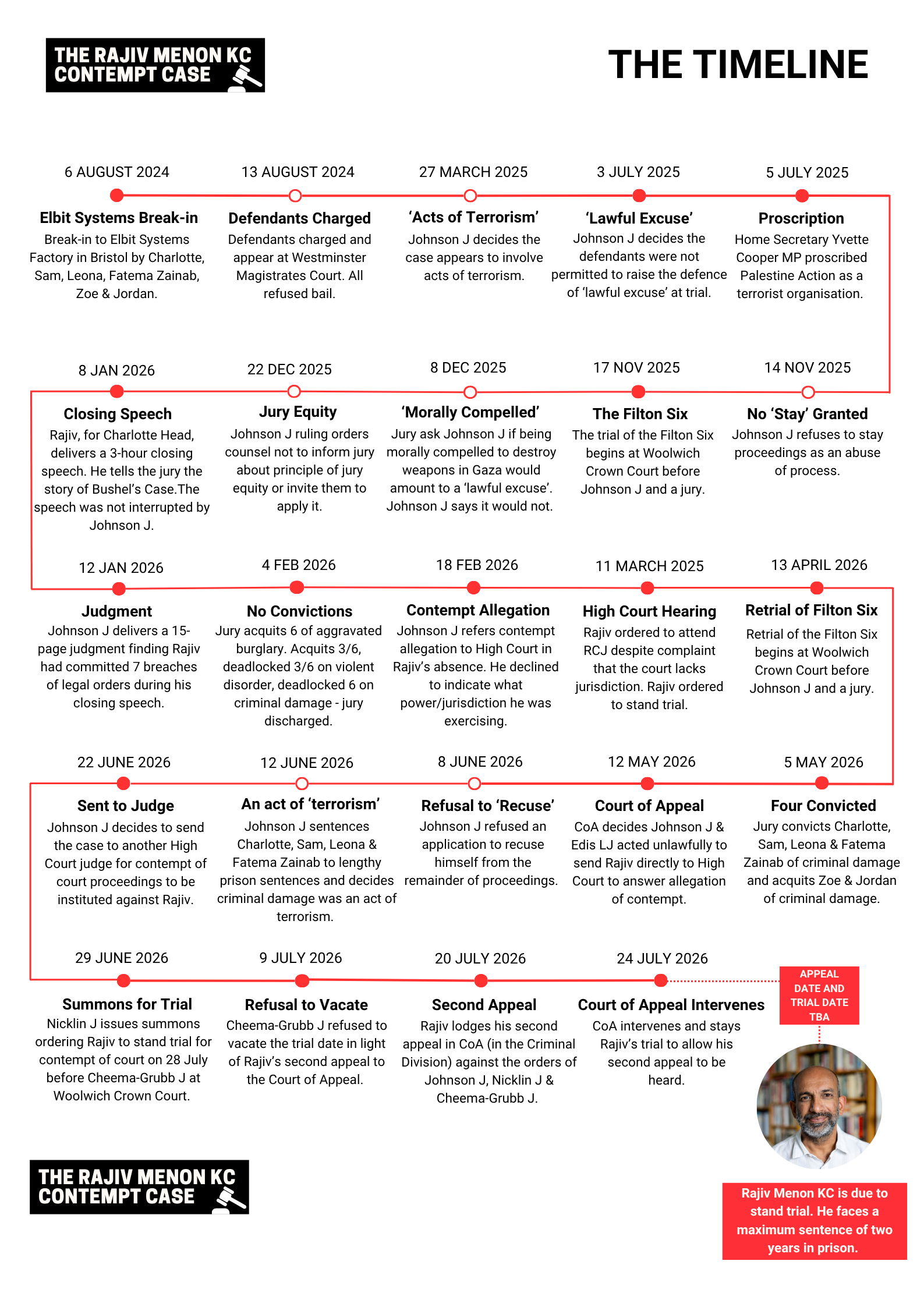
Along the same lines the Palestine Action protestors, the ‘Filton 6’ were charged with aggravated burglary under the Theft Act 1968[33] after they broke into an arms factory on August 6th, 2024, because they believed it was selling arms to Israel. They caused damage to machinery and to security guards. Like the Colston Four, the Filton 6 were protesters. The jury asked Justice Johnson[34] whether being “morally compelled” to act would be a defence in the case, and he told them it would not. He then instructed counsel not to refer to “jury equity” and not to ask jurors to apply it. Rajiv Menon KC gave a lengthy closing speech on behalf of his client Charlotte Head where he did discuss Bushell’s case. While he did not interrupt the speech Justice Johnson did rapidly file a 15-page finding of contempt against the barrister, which was overturned on appeal on procedural grounds. The jury subsequently returned ‘not guilty’ verdicts for the burglary charges, despite the evidence against them, and divided on the other charges.[35]
However, there was then a retrial where four of the defendants, including Charlotte Head, were convicted of criminal damage, and sentenced by Justice Johnson to lengthy prison sentences on the basis of this being an instance of terrorism. Again, Justice Johnson referred Rajiv Menon for contempt, which remains pending as of September 5th, 2026.[36]
Rajiv Menon’s chambers describes the case in the following, stark terms:
After more than 30 years representing clients in some of the country’s most significant public interest cases, criminal defence and human rights barrister Rajiv Menon KC is facing contempt of court proceedings that carry a potential prison sentence of 2 years. Rajiv is being prosecuted over the closing speech he delivered in defence of Charlotte Head, a young woman who was involved in a direct action against a factory in Filton belonging to Elbit Systems, Israel’s largest arms manufacturer. The case brought against Rajiv is unprecedented. It is believed to be the first time in British legal history that a lawyer is being prosecuted for contempt for words spoken during a closing speech.
But this is about far more than one lawyer or one trial. The precedent this case sets could weaken the foundations of our justice system, undermine the freedom of lawyers to fearlessly represent the interests of their clients, and endanger the fundamental right to a free and fair trial.[37]
Understandably, the chair of the Criminal Bar Association said this:
people at the criminal bar have become uncertain and scared of what they can and can’t say; scared that somehow they might be – at the end of a trial where they have faithfully represented their client themselves – facing a charge of criminal contempt.[38]
As far away as Lviv, in the Ukraine, where people are perhaps aware of the dangers of oppressive governmental power, a newspaper opined on Rajiv Menon’s case:
The strength of a legal system is measured not by how comfortably it handles popular litigants but by how confidently it protects the rights of those whose causes provoke hostility. The freedom of advocates to defend such clients without fear of personal prosecution is not an indulgence. It is one of the principal guarantees that courts remain places where justice is determined by law rather than by power.[39]
Thus 350 years on Bushell’s Case is definitely under threat.
©Clive Stafford Smith
References
[1] This year I worked quite closely with one of my Bristol students, Jacob Baker, who did some inspired work on the prerogative of mercy, focusing on the fact that magistrates have no such power – a bizarre notion when one thinks that someone before the higher courts faces a jury that does (albeit a right that seems to be rapidly eroding). I have purloined much of Jacob’s research for this piece, and I wish to acknowledge that, and thank him for it. Others, including Chloe Lee, Rua Alrefaie and Shara Vijaykumar, did very good work and I have borrowed from them also.
[2] J E R Stephens, ‘The Growth of Trial by Jury in England’, 10 Harvard Law Review 150, 152 (1896).
[3] Constitutions of Clarendon (1164).
[4] The mort d’ancestor was a 12th-century common law English possessory writ used by an heir, on the death of a relative, to reclaim land unlawfully seized by a stranger.
[5] Theodore F. T. Plucknett, Concise History of the Common Law, at 126 (Boston, Little, Brown, and Co.).
[6] K.J. Kesselring, ‘Felons’ Effects and the Effects of Felony in Nineteenth-Century England’ 28(1) Law and History Review (2010).
[7] Bushell’s Case (1670) 124 ER 1006 (CP). Note that the name is sometimes spelled with one l (Bushel) but for reasons of consistency only here we will use two.
[8] Kevin Crosby, ‘Bushell’s Case and the Juror’s Soul’, 33(3) Journal of Legal History 251, 257 (2012).
[9] John Vaughan, ‘The Opinion of Sir John Vaughan, Chief Justice of the Court of Common Pleas, on the 9th of November, 1670, When the Case of Edward Bushell, One of the Jurors in the Famous Case of Penn and Mead, Came to be Argued on Writ of Habeas Corpus’ in ‘The Belfast Monthly Magazine’ (Volume 8, No. 42, 1812)
[10] Id. 260.
[11] United States v. Thomas, 116 F.3d 606 (2d Cir. 1997); see also Nancy J King, 'Jury Nullification in the United States' in ‘Oxford Handbook Topics in Criminology and Criminal Justice’ (first published 2012, online edn, Oxford Academic, 2 June 2014), https://doi.org/10.1093/oxfordhb/9780199935383.013.103 (accessed 2026.09.05).
[12] Federal Rules of Criminal Procedure, FRCP 23(b) (Jury or Nonjury Trial).
[13] United States v. Thomas, 116 F.3d 606 (2d Cir. 1997).
[14] Jack Weinstein, 'Considering Jury ‘Nullification: When May and Should a Jury Reject the Law To Do Justice', American Criminal Law Review 239–354 (30th edn, 1993).
[15] Taylor v. Louisiana, 419 U.S. 522 (1975).
[16] Coleman v. Zant, 708 F.2d 541 (11th Cir. 1983), citing Rideau v. Louisiana, 33 U.S. 723, 83 S. Ct. 1417, 10 L. Ed. 2d 663 (1963); Johnson v. State, 476 So. 2d 1195, 1210, 1214‑15 (Miss. 1985) (change of venue is "automatically" required when prejudicial publicity has "saturated" the community).
[17] Strauder v. West Virginia, 100 U.S. 303 (1880).
[18] Id. 100.
[19] Taylor v. Louisiana, 419 U.S. 522, 419 (1975).
[20] Vivian N Rotenstein and Valerie P Hans, ‘Gentlewomen of the Jury’, Michigan Journal of Gender & Law (2023).
[21] Duren v. Missouri, 439 U.S. 357, 364, 99 S. Ct. 664, 668, 58 L. Ed. 2d 57, 586-87 (1979). A prima facie case under the Fourteenth Amendment equal protection clause is quite similar. The defense must show that (1) the group alleged to be discriminated against is a cognizable class; (2) there has been a significant underrepresentation of the class over a period of time; and (3) the selection procedure is subject to abuse or is not class neutral. Castaneda v. Partida, 430 U.S. 482, 494, 97 S. Ct. 1272, 1280, 51 L. Ed. 2d 498, 510-11 (1977).
[22] See Castaneda, 430 U.S. at 497‑98, 97 S. Ct. at 1282, 51 L. Ed. 2d at 512.
[23] Whitus v. Georgia, 385 U.S. 545, 551, 87 S. Ct. 643, 647, 17 L. Ed. 2d 599, 604 (1967); Alexander v. Louisiana, 405 U.S. 625, 632, 92 S. Ct. 1221, 1226, 31 L. Ed. 2d 536, 543 (1972); Turner v. Fouche, 396 U.S. 346, 361, 90 S. Ct. 532, 540, 24 L. Ed. 2d 567, 579 (1970); Norris v. Alabama, 294 U.S. 587, 598, 55 S. Ct. 579, 583, 79 L. Ed. 1074, 1081 (1935).
[24] Id., at 1316. See also Rosales-Lopez v. United States, 451 U.S. 182, 188, 101 S. Ct. 1629, 68 L. Ed. 2d 22 (1981).
[25] The notion that this essentially rigs the jury is misplaced. Any practicing lawyer who uses peremptory challenges knows that there are always jurors who mouth the right words so that the judge must find they cannot be struck for cause, but who are clearly either lying to get on the jury, or biased in one form or another. Consider the twelfth juror in the recent Lindsay Clancy trial who agreed with the other eleven that she was probably not guilty by reason of insanity, but refused to vote that way. See Judge Declares Mistrial in Lindsay Clancy Triple-Murder Case, New York Times (Sept. 5, 2026), https://www.nytimes.com/live/2026/09/04/us/lindsay-clancy-trial-deadlock.
[26] Batson v Kentucky 476 U.S. 79 (1986).
[27] JEB v Alabama ex rel TB, 511 U.S. 127 (1994).
[28] In many ways the lawyer’s duty is the same on both sides of the Atlantic – all lawyers, for example, have an ethical duty to be honest, and not present false evidence. But no American lawyer would be “professionally embarrassed” if the client said he did the offence, and yet insisted on putting the government to its proof. The lawyer could not call the client to testify falsely, but could certainly point out the weaknesses in the government’s case. But this duty to the client becomes much less contentious when the case involves what may be seen as a fundamental inequity in the law – as with issues where the government overreaches or, in the case of the death penalty, where the government seeks to impose a penalty with which a large number of citizens have moral objections.
[29] Attorney General’s Reference (No.1) [2022] EWCA Crim 1259.
[30] Section 1 Criminal Damage Act 1971; Attorney General’s Reference (No.1) [2022] EWCA Crim 1259.
[31] Section 5 Criminal Damage Act 1971
[32] Steven Cammiss, Brian Doherty, Graeme Hayes ‘We attended the trial of the Colston four: here’s why their acquittal should be celebrated’, The Conversation (Jan. 1, 2022), available at https://theconversation.com/we-attended-the-trial-of-the-colston-four-heres-why-their-acquittal-should-be-celebrated-174481 (accessed 2026.09.05).
[33] Section 10 Theft Act 1968.
[34] Sir Adam Johnson is seen by some as a judge who has made something of a cause out of curbing the jury’s use of its nullification prerogative. His background is mainly in commercial litigation, formerly as a solicitor at Herbert Smith, and he was appointed to the Chancery Division of the court, which deals with business, trusts, probate and land law. It is arguable that objectivity in assessing the meaning of contracts, trusts, wills and property is rather different from criminal law.
[35]'VICTORY! NO convictions at end of Filton trial’ (Free the Filton 24, 2026), available at https://filtonactionists.com/victory-no-convictions-at-end-of-filton-trial/ (accessed 2026.09.05).
[36] See https://gardencourtchambers.co.uk/wp-content/uploads/2026/07/Rajiv-Menon-KC-Contempt-Proceedings-Timeline.png (accessed 2026.09.05).
[37] https://gardencourtchambers.co.uk/news/rajiv-menon-kc-contempt-proceedings/ (accessed 2025.09.06) (note that Garden Court Chambers is Rajiv Menon’s chambers and has historically been seen as one of the most liberal of all groups of barristers in the U.K.).
[38] Haroon Siddique, Palestine Action barrister’s prosecution criticised as ‘chilling’, The Guardian (July 23, 2026), available at https://www.theguardian.com/uk-news/2026/jul/23/palestine-action-trial-lawyer-prosecution-criticised-rajiv-menon-kc (accessed 2026.09.05).
[39] The Advocate in the Dock: Why the Rajiv Menon KC Contempt Proceedings Raise Profound Questions About Judicial Power, Lviv Herald (July 23, 2026), available at https://www.lvivherald.com/post/the-advocate-in-the-dock-why-the-rajiv-menon-kc-contempt-proceedings-raise-profound-questions-about (accessed 2026.09.05).
This event was on Thu, 17 Sep 2026

Support Gresham
Gresham College has offered an outstanding education to the public free of charge for over 400 years. Today, Gresham College plays an important role in fostering a love of learning and a greater understanding of ourselves and the world around us. Your donation will help to widen our reach and to broaden our audience, allowing more people to benefit from a high-quality education from some of the brightest minds.