Login


Women of Bath and Willesden: Ordinary Women in English Literature

Share

- Details
- Text
- Audio
- Downloads
- Extra Reading
In this lecture, Professor Marion Turner explores ‘ordinary women’ in English literature, arguing that Chaucer’s 14th-century Wife of Bath was the first such woman: a middle-aged, sexually active working woman who tells the outrageous story of her own life.
Zadie Smith’s 21st century translation of her story demonstrates the ongoing relevance of thinking about the space we have for women’s voices in theatre, poetry and public life. This lecture discusses the historical context for the emergence of the voices of ‘ordinary women’ in literature and considers what has and hasn’t changed across time.
Download Text

Women of Bath and Willesden: Ordinary Women in English Literature
Marion Turner, J.R.R. Tolkien Professor of English Literature and Language, University of Oxford
Wednesday 30th September 2026
Summary
Prof Turner explores ‘ordinary women’ in English literature, arguing that Chaucer’s 14th-century Wife of Bath was the first such woman: a middle-aged, sexually active, working woman, who tells the outrageous story of her own life. Zadie Smith’s 21st century version demonstrates the ongoing relevance of thinking about how much space we have for women’s voices on the stage, in poetry, and in public life. This lecture explores the historical context for the emergence of ‘ordinary’ women’s voices in literature and considers what has and hasn’t changed across time.
Introduction
- Discusses Zadie Smith’s Wife of Willesden as a translation / adaptation of Chaucer’s Wife of Bath’s Prologue and Tale. Chaucer wrote in the fourteenth century; Smith closely follows his text in the twenty-first, but updates the setting and references.
- Gives some brief context for the two authors and texts: Chaucer (c.1342-1400) wrote in the wake of the plague, at a time of social change. He himself was a Londoner, the son of a vintner. His Canterbury Tales is a tale-collection that explores different voices, genres, and forms. Smith, writing today, is primarily known as a novelist and essayist: this is her first play and was written specifically to celebrate her local area in London.
- Compares the opening of the two texts, showing how Smith uses the same poetic form as Chaucer (the iambic pentameter), but brings in Jamaican dialect.
- Poses the question of why medieval literature still resonates so much today, with so many authors and readers.
QUOTE: THE TWO OPENINGS (IN THE ORIGINAL TEXTS)
Let me tell you something: I do not need
Any permission or college degrees
To speak on how marriage is stress. I been
Married five damn times since I was nineteen!
From mi eye deh a mi knee. But I survived,
(Zadie Smith, The Wife of Willesden, 2021)
Experience, though noon auctoritee
Were in this world, is right ynogh for me
To speke of wo that is in marriage;
For, lordynges, sith I twelve yeer was on age,
Thonked be God that is eterne on lyve,
Housbondes at chirche dore I have had five—
(Geoffrey Chaucer, The Wife of Bath’s Prologue from The Canterbury Tales, c. 1390)
- Notes that in both texts, the idea of ‘authority’ and ‘experience’ are juxtaposed – but are deceptive. Both texts are, in fact, drawing on written authority while claiming to be based on lived experience…
Medieval Women
- Describes the kinds of women that were mainly found in literature before Chaucer – queens and damsels, whores and old hags, saints and nuns. These tended to be two-dimensional stereotypes, idealized or reviled.
- Contrasts this with the kind of women that lived and worked in 14th century England. Women did a wide range of jobs, and benefitted from (relatively) good inheritance laws, for instance. They were protected under the law and, while they were still second-class citizens, they had more rights than many people imagine.
- Discusses the so-called ‘golden age’ for women in the fourteenth and fifteenth centuries, exploring the post-plague context, the European marriage pattern, and the different situation in various parts of the world. North-western Europe had much better conditions for women, legally, culturally, and economically, than other parts of Europe, for instance.
- Focuses on the kind of jobs that women did in medieval England, both their more typical work, in cloth, victualling, and service, and the more unusual women who worked as blacksmiths or scribes, for example. Contrasts women’s working roles in England with some other countries. In Italy, for instance, enslaved women were increasingly exploited in the post-plague world.
- Discusses emerging women writers in the later-medieval period. In Chaucer’s lifetime, we see the first named women writers writing in English. Julian of Norwich and Margery Kempe were important figures; meanwhile, in France, Christine de Pizan, writing just after Chaucer, made many similar points about women’s voices.
Chaucer and Medieval Women
- Explains a bit about Chaucer’s importance and his world
- Argues that Chaucer’s Wife of Bath is the first ordinary woman in English literature: a middle-class, middle-aged, sexually active, working woman who travels, sees her friends, talks about sex, and sees the importance of economic independence. (She is also extraordinary in other ways, an excessive, exuberant character!)
- Shows how Chaucer transformed his (mainly antifeminist) sources, especially the character of La Vielle in the Romance of the Rose, to make a more interesting, rounded, three-dimensional character. He takes a stereotypical figure of an old prostitute / bawd and turns her into an essentially respectable much-married woman. He takes a cynical figure and gives her hope and humour. He takes us into his character’s memory, thoughts, suffering, and desires. That does not mean that his Wife of Bath is idealized – she is a complex and problematic figure.
Books of Wicked Wives
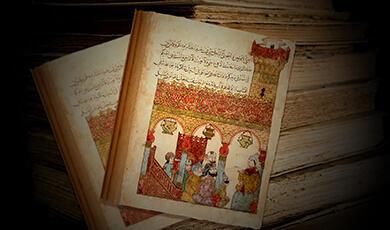
- Discusses the importance of the scene in the Wife of Bath’s Prologue in which her husband reads a collection of misogynist books, the book of wicked wives
- QUOTE FROM THE WIFE OF BATH’S PROLOGUE (IN TRANSLATION):
He had a book he loved to read, that he
Read night and morning for his own delight […]
And night and morning it was his custom
Whenever he had leisure and freedom
From any other worldly occupation
To read in it concerning wicked women […]
But to the point – why I got beaten up,
As I was telling you, just for a book
- Explains the kinds of books they are, and the dominance of such books – manuscripts in which many misogynist texts were all bound together. There are examples of real manuscripts like this.
- Demonstrates Chaucer’s concern with getting across the bias of the canon and women’s lack of opportunity to be heard.
- Discusses the radical nature of what Chaucer, via the Wife of Bath, is saying about who gets to speak. It is fascinating, and extremely unusual, that Chaucer wanted to make this point.
The Wife of Bath across time
- Argues that the Wife of Bath has had extraordinary influence for the last 600 years; many writers and readers have wanted to retell her story.
- Shows how early scribes, eighteenth-century poets, twentieth-century novelists, and modern film-makers responded to her and wrote new versions of her
- Demonstrates the different kinds of responses: attempts to silence her, to contradict her, to simplify her, to rehabilitate her. Many writers are made uncomfortable by her in different ways. Across time, we often see writers trying to censor what she is saying (by removing parts of her text), or to mock and humiliate her (by adding to her story, or simplifying her character – sometimes making her more like the source versions) or to domesticate her and make her safe (for instance by turning her into a devoted mother, in one version).
Twenty-first century Wives of Bath
- Discusses the fact that in the twenty-first century, women are increasingly responding to and writing new versions of the Wife of Bath, and as a result, she is being treated in quite different ways. Before the twenty-first century, there were very few female-authored adaptations.
- Says a bit about the poets Patience Agbabi and Caroline Bergvall and the actor Maite Proenca who have all performed the role of the Wife of Bath in new versions over the last couple of decades. It is really interesting to see how much interest there still is in this fourteenth-century character, and how many writers still want to write and perform new versions of her today.
Zadie Smith’s Wife of Willesden
- Describes Zadie Smith’s adaptation of the Wife of Bath, her 2021 play, The Wife of Willesden – Smith’s first play, performed in the Kiln Theatre in London (and later also in Boston and New York)
- Quotes from Smith’s description of her interest in Chaucer and her creative process in writing The Wife of Willesden
QUOTE FROM ZADIE SMITH
“ when I sat down to write The Wife of Willesden I had no idea it would end up being one of the more delightful writing experiences of my life. I think, when we talk about ‘creativity’, not enough is said about the interesting role that limits, rules and restrictions can play. In this case, the rules of the game were almost absurdly constricting: a medieval text – concerning sexual politics that would seem as distant as the moon – constructed in rhyming couplets from lines of ten syllables each. Yet from the moment Alyson opens her mouth –
Experience, though noon auctoritee
Were in this world, were right ynogh to me
To speke of wo that is in marriage
- I knew that she was speaking to me, and that she was a Kilburn girl at heart.”
(Zadie Smith, Introduction)
Continuities
- What stays the same in the new version? This section engages with the very troubling elements of the Wife of Bath’s Prologue and Tale that deal with domestic violence and rape, and how Smith engages with these issues. Interruption and mansplaining are foregrounded in Smith’s text, as they are in Chaucer’s original.
- Shows what Smith does with Chaucer’s ‘book of wicked wives’: misogynist books still abound. Rather than being bound together in one volume, algorithms will lead you from one to another:
QUOTE FROM THE WIFE OF WILLESDEN:
HUSBAND RYAN
It’s made of some books I’ve put together,
Twelve Rules of Life; The Myth of Male Power;
The Game; something called The Woman Racket
ALVITA
(Some mental crap he got off the internet)
Changes
- Discusses the fact that the form of drama offers different affordances in comparison to Chaucer’s tale. Chaucer’s work was also often performed orally, but a play with multiple characters, props and scenes, is still a very different genre. The play form also means that the same actors perform across the Prologue and Tale, drawing more specific comparisons between the two.
- Explores Smith’s decision to transport Chaucer’s Arthurian Tale to Jamaica. Smith is bringing in new aspects of Englishness and English history, alongside the medieval tradition.
- Explores changes that Smith made to the ending, especially her focus on how we think about older women: the old hag transforms not into a young woman, but into Alvita, the Wife of Willesden, herself.
- Discusses what has changed for women readers and writers in the twenty-first century. Sets this in the context of thinking about who gets to speak, to tell their story.
References and Further Reading
Key Reading:
Geoffrey Chaucer, The Wife of Bath’s Prologue and Tale (available in many editions, including The Riverside Chaucer, in Middle English, or in many good translations, including one by David Wright and another by Nevill Coghill. An interlinear medieval and modern version is easily available online at the Harvard Chaucer pages: https://chaucer.fas.harvard.edu/pages/wife-baths-prologue-and-tale-0)
Zadie Smith, The Wife of Willesden (Penguin: 2021)
Marion Turner, The Wife of Bath: A Biography (Princeton: 2023)
Further contextual reading:
Betsy Bowden, The Wife of Bath in Afterlife: Ballads to Blake (Lehigh: 2017)
Steve Ellis, Chaucer at Large: The Poet in the Modern Imagination (Minnesota: 2000)
Kathleen Coyne Kelly and Tison Pugh, Chaucer on Screen (Ohio: 2013)
Kathleen Forni, Chaucerian Afterlife: Adaptations in Recent Popular Culture (McFarland: 2013)
Clare Broome Saunders, Women Writers and Nineteenth Century Medievalism (Palgrave: 2009)
Stephanie Trigg, Congenial Souls: Reading Chaucer from Medieval to Postmodern (Minnesota: 2002)
Marion Turner (ed.), Chaucer Here and Now (Bodleian Publishing: 2023)
This event was on Wed, 30 Sep 2026

Support Gresham
Gresham College has offered an outstanding education to the public free of charge for over 400 years. Today, Gresham College plays an important role in fostering a love of learning and a greater understanding of ourselves and the world around us. Your donation will help to widen our reach and to broaden our audience, allowing more people to benefit from a high-quality education from some of the brightest minds.