
 Login
Login

Professor Goriely's lecture "The Shape of Shells" inspires abstract art
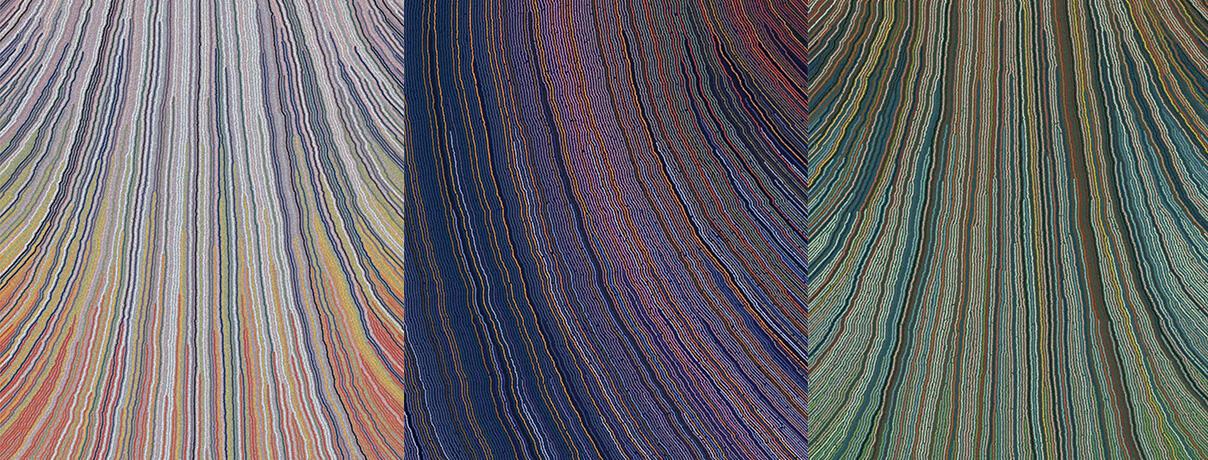
Professor of Geometry Alain Goriely’s lecture at Gresham College, The Shape of Shells: She Sells Self-Similar Spiral Seashells on the Seashore, reveals the maths behind the shape of seashells.
Seashells are everywhere, cherished for their natural beauty, symmetry and diversity of colour and form.
In his recent lecture, Professor Goriely reveals how seashells’ geometry is governed by simple mathematical rules, producing elegant three-dimensional, self-similar spirals.
For Margate-based artist Tony Kit Kirk, the lecture offered not just scientific insight, but creative ignition. Living on the Kent coast, surrounded by seashells, Tony found in Professor Goriely’s explanation of shell growth a reflection of his own artistic work:
“As a neurodivergent generative artist, I’ve always been drawn to the beauty of simple underlying systems. My work often involves finding ways to visualise the small, intricate details of the world.
"Professor Alain Goriely’s lecture resonated with me because it framed shell growth as a visual record of mathematical history.
"The lecture presents this as a self-similar, fractal process following a relatively stable numeric sequence. Numerical, iterative, and emergent processes like these are fundamental building blocks of generative art, so the connection felt very natural.”
Tony created the artwork by writing a JavaScript algorithm that mimics shell growth. From a simple row of points, the subsequent rows grow outward from the centre. Then, when gaps appear between points, the program adds new points to fill them. The linear structure we see are the paths that connect these points, with colour mapping the age of each path.
“I also wove pseudo-randomness throughout the code to ensure the final forms retain an organic, imperfect quality. Each time the code runs, it generates a new variation of the system, creating an endless range of outcomes,” Tony explains.
Professor Goriely responded, “I am touched and delighted to see mathematical ideas reinterpreted through art. When an artist, such as Tony, translates such processes into art, they reveal not only the structure of nature, but also the deep link between mathematics, biology, and creative expression.”
Tony describes Gresham College lectures as “an invaluable resource”; he looks forward to “drawing further inspiration from the many lectures [on his] watchlist”.
Tony’s work can be found on Instagram at @tonykitkirk.
The maths of nature... in glass?
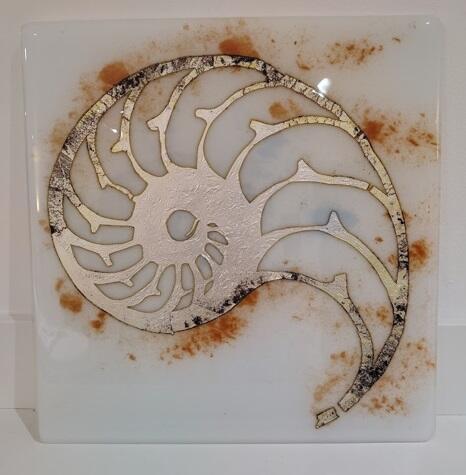
© Becca Rowland
Fused glass artist Becca Rowland, inspired by Professor Goriely's lecture The Shape of Plants: Why Plants Love Mathematics and Mathematicians Love Plants, wanted to create something that represented how the Fibonacci sequence expresses itself in nature. She crafted this cross section of a nautilus shell, made from a type of glass that reacts with silver.
"Much of my glasswork takes inspiration from patterns we see all around us. Sometimes I use the way hot glass will flow into voids to create those patterns or, as in this case, I work with the reactions that occur between glass containing different elements, which is what gives the colour or the reactions between a particular type of glass and a metal such as silver," she explains.
Becca’s work can be found on Instagram at @rebecca.rowland99.