
 Login
Login

Peacebuilding through the Visual Arts
Share

- Details
- Text
- Audio
- Downloads
- Extra Reading
How can the visual arts be used to promote peace? Professor Mitchell investigates how the visual arts can not only incite violence, but also bear witness, reveal dangerous memories, transform violence, contribute to healing trauma and imagine more hopeful futures. Examples are taken from both current conflicts (Russia-Ukraine, Israel-Palestine) and past wars (Paul Nash and Otto Dix in the First World War, local artists in the Iran-Iraq War and the 1984 Rwandan genocide). Professor Mitchell analyses the ambivalent role of the visual arts in building peace.
Download Text

Peacebuilding through the Visual Arts
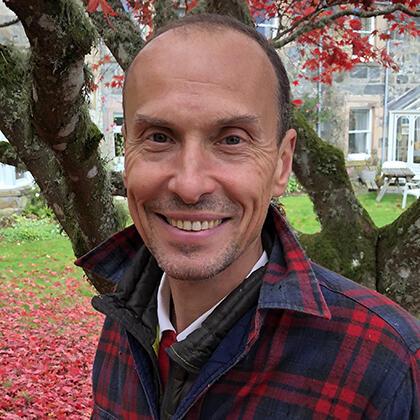
Professor Jolyon Mitchell, FRSA
Wednesday 11 February 2026
Summary
How can the visual arts be used to promote peace? Professor Mitchell investigates how the visual arts can not only incite violence, but also bear witness, reveal dangerous memories, transform violence, contribute to healing trauma and imagine more hopeful futures. Examples are taken from both current conflicts (Russia-Ukraine, Israel-Palestine) and past wars (e.g. Paul Nash and Otto Dix in the First World War, and the 1984 Rwandan genocide). Professor Mitchell analyses the ambivalent role of the visual arts in building peace.
Lecture Outline
Introduction
Representing Heartbreak, Grief and the Pity of War
-
Art that Bears Witness
-
Dangerous Memories (The Killing Churches)
-
Current Conflicts
-
Religious Beliefs
The Ambiguities of Bearing Witness
-
Art that Transforms Violence
-
On Stage
-
After a Civil War
-
Turning ‘Swords Into Ploughshares’
The Ambivalence of Transforming Violence
-
Art that Imagines Hopeful Futures
-
Painting on Walls
-
Sculpting Hope
-
Reaching for Peace
‘Hope is a Dangerous Thing’
Conclusions: Art that Heals and Grows Peace?
© Jolyon Mitchell 2026
Appleby, Scott, The Ambivalence of the Sacred: Religion, Violence, and Reconciliation. Lanham: Rowman and Littlefield, 2000.
Armstrong, Karen, Fields of Blood: Religion and the History of Violence. London: Vintage, 2015.
Banks, M. H. and Christopher Mitchell. Handbook of Conflict resolution: The Analytical Problem-Solving Approach. London: Pinter, 1996.
Bruckner, D. J. R, Seymour Chwast, and Steven Heller, Art Against War: 400 Years of Protest in Art (New York, NY: Abbeville Press, 1984).
Buttner, Nils ed. Otto Dix and the New Objectivity (Stuttgart, Germany: Hatje Cantz, 2013).
Cortright, David. Peace: A History of Movements and Ideas, Cambridge: Cambridge University Press, 2008.*
de Gruchy, John W. Christianity, Art, and Transformation: Theological Aesthetics in the Struggle for Justice. Cambridge: Cambridge University Press, 2001.
Harries, Merrion and Susie, The War Artists (London, UK: Michael Joseph, IWM and Tate, 1983)
Janes, Dominic and Alex Houen, editors Martyrdom and Terrorism: Pre-Modern to Contemporary Perspectives. Oxford: Oxford University Press, 2014.
Kollwitz Käthe, The Diary and Letters of Kaethe Kollwitz (Evanston, IL: Northwestern University Press, 1988 [1955]).
Lederach, John Paul. Building Peace: Sustainable Reconciliation in Divided Societies. Washington, DC: United States Institute of Peace Press, 1997.*
Lederach, John Paul. Little Book of Conflict Transformation. Intercourse, PA: Good Books, 2003.
Lederach, John Paul. The Moral Imagination: The Art and Soul of Building Peace. New York: OUP, 2010.
Lederach, John Paul and Angela Jill Lederach. When Blood and Bones Cry Out: Journeys Through the Soundscape of Healing and Reconciliation. New York: OUP, 2011.
Loffler, Fritz Otto Dix: Life and Work, translated by R.J. Hollingdale, (New York: Holmes and Meier, 1982)
MacGregor, Neil, A History of the World in 100 Objects (London, UK: Penguin, 2010).
Mitchell, Jolyon. Martyrdom: A Very Short Introduction. Oxford: Oxford University Press, 2012.
Mitchell, Jolyon and Rey, Joshua. War and Religion: A Very Short Introduction. Oxford: OUP, 2021
Mitchell, Jolyon. Promoting Peace, Inciting Violence: The Role of Religion and Media. London and New York: Routledge, 2012.
Mitchell, Jolyon. Media Violence and Christian Ethics. Cambridge: Cambridge University Press, 2007.
Mitchell, Jolyon et al, editors, Peacebuilding and the Arts. New York: Palgrave – MacMillan, 2019.
Mitchell, Jolyon et al, Editors, The Blackwell Companion to Religion and Peace. Oxford: Blackwell,2022.
Murphy, Andrew R. The Blackwell Companion to Religion and Violence. Oxford: Blackwell, 2010.
Nash, Paul, Outline : an Autobiography and Other Writings (London, UK: Faber & Faber, 1949).
Omer, Atalia; R. Scott Appleby and David Little, eds., The Oxford Handbook of Religion, Conflict, and Peacebuilding. Oxford: Oxford University Press, 2015.
Powers, Gerard F. and Daniel Philpott, eds., Strategies of Peace: Transforming Conflict in a Violent World, Oxford: Oxford University Press, 2010.
Ramsbotham, Oliver, Tom Woodhouse and Hugh Miall. Contemporary Conflict Resolution. 3rd Edn. London: Polity Press, 2011.
Richmond, Oliver. Peace: A Very Short Introduction. Oxford: Oxford University Press, 2014.
Sontag, Susan, Regarding the Pain of Others (London, UK: Penguin, 2004 [2003])
Thacker, Toby, British Culture and the First World War: Experience, Representation and Memory (London, UK: Bloomsbury, 2014).
Volf, Miroslav. The End of Memory: Remembering Rightly in a Violent World,
Grand Rapids, MI: W.B. Eerdmans, 2006.
Winter, Jay Sites of Mourning, Sites of Memory: The Great War in European cultural history. Cambridge: Cambridge University Press, 1995.
Winter, Jay, Sites of Memory, Sites of Mourning: The Great War in European Cultural History (Cambridge, UK: Cambridge University Press, 1995).
Young, Nigel, editor: The Oxford International Encyclopedia of Peace (Oxford, UK: Oxford University
Press, 2010).
This event was on Wed, 11 Feb 2026
Support Gresham
Gresham College has offered an outstanding education to the public free of charge for over 400 years. Today, Gresham College plays an important role in fostering a love of learning and a greater understanding of ourselves and the world around us. Your donation will help to widen our reach and to broaden our audience, allowing more people to benefit from a high-quality education from some of the brightest minds.