
 Login
Login

Current Challenges to the US Constitution

Share

- Details
- Text
- Audio
- Downloads
- Extra Reading
The Americans are very proud of their written constitution. During the first 3/8 of President Trump’s second term of office, the constitution has been severely tested. Where has the Constitution succeeded in providing legal safeguards, clarity and stability, and where has it failed? How will the remainder of this presidency look? And what is coming after Trump?
Download Text

Current Challenges to the US Constitution
Is the U.S Supreme Court Surviving as a Constitutional Brake on President Donald J. Trump
Professor Clive Stafford Smith JD OBE
4 June 2026
Here we are, sixteen months into Donald J. Trump’s second term. He does seem more active than in his first term, and arguably backed by more sycophantic supporters in his cabinet. He has the Republican party in his thrall, which has uncertain consequences for the party and the country. And he has challenged various norms of the U.S. Constitution and plans to keep on doing it. It is time to evaluate, then, whether he or the Constitution is winning the battle.
Much has been said about the impending demise of the U.S. Constitution in his second term: he appointed three of the nine justices (Neil Gorsuch, Brett Kavanaugh and Amy Coney Barrett) so that six of the justices (also including Clarence Thomas, Samuel Alito and Chief Justice Roberts) are viewed as solidly conservative, as against the three who are tagged “liberal” (Sonia Sotomayor, Elena Kagan and Ketanji Brown Jackson). To be sure, in past years the Court has issued some surprising and dubious rulings, including essentially giving the president immunity for any crime, perhaps even including murder.[1] Nevertheless, rumours of the Constitution’s death are proving to be exaggerated – perhaps some of the members of the Court have recognized their important role in the constitutional scheme and, notwithstanding some personal criticisms levelled at him by his doubters, Chief Justice Roberts is generally acting in a consensual manner.
Let us begin by accepting that there is a heated struggle for the prize when it comes to the most vilified Supreme Court decision of all time, and thus far the Roberts court has not really challenged for top place. To be sure, the overrule of Roe v. Wade had less to do with law than philosophy, but the current leaders on the board are going to present stiff competition.
Personally I favour Dred Scot v. Sandford, 60 U.S. 393 (1857), for pole position – the awful case that held that African Americans were not even Americans, a case that itself contributed to the outbreak of the Civil War four years later. This term sees a right wing effort to replicate Dred Scot by rubber stamping Trump’s effort to strip people of birthright citizenship, but I expect it will be turned back.
Then there was Plessy v. Ferguson, 163 U.S. 537 (1896), which accepted “separate but equal” as a way to deal with racism. The current court has adopted the notion that there are no residues of racism left in the U.S. which is a pernicious fantasy but hardly one that will overtake Plessy.
Another favourite for all-time folly is Buck v. Bell, 274 U.S. 200 (1927), where the Court found it acceptable that “the superintendent of the State Colony for Epileptics and Feeble Minded was ordered to perform the operation of salpingectomy upon Carrie Buck for the purpose of making her sterile.” The eugenics movement was closely aligned to other dark moments in U.S. history.
Some put forward Korematsu v. United States, 323 U.S. 214 (1944), where the U.S. locked up all Japanese Americans for the simple crime of being genetically affiliated with the people who bombed Pearl Harbor. It took fifty years for people to accept that this was a dreadful, racist mistake (many people came to the U.S. from Japan to escape the fascist militarism on the rise there), and it is an emotive one for me, since I was part of the case that put Korematsu to bed. Rasul v. Bush, 542 U.S. 466 (2004) (applying the writ of habeas corpus to Muslims in Guantánamo Bay).
To be honest, I was surprised to see Bowers v. Hardwick, 478 U.S. 186 (1986), close out the popular Top Five. It is another personal favourite of mine – the case essentially held, for fundamentally homophobic reasons, that all sexual acts other than the missionary position between consenting married adults could be criminalized. I represented some people in Georgia in the 1990s for the heinous crime that we called “tongilingus prohibitum” (the Attorney General thought that was a real Latin phrase) but it can hardly be in the same vile class as Dred Scot.
Anyway, all that is to say that if you want to convince me that the Republic is about to fall because of the dissolution of the legal system, all these are tough acts to out-do.
* * * * * *
I don’t think the system is crumbling. Indeed, I think Donald Trump is losing.
My thesis is illustrated by a review of the 35 decisions thus far in the 2025 term.[2] Forgive me more “law” that you probably expect from me, but the argument goes as follows: Eight of the cases were disposed of per curiam, meaning that the opinion was not assigned to, or signed by, a particular justice. Of the remaining 27 cases, one might expect nine justices to receive three each, but the liberals have averaged 4 (5 assigned to Sotomayor, 4 to Jackson, and 3 to Kagan). Only Thomas (5) has matched them, with Gorsuch (3) on average, and Alito (2), Barrett (2), Roberts (2), and Kavanaugh (1) having fewer. Since the most senior justice in the majority assigns any case to himself or one of the others, this means that Chief Justice Roberts has given a surprising number of cases to the liberals to write.[3]
When it comes to the other decisions, what is perhaps even more surprising is that 22 of the decisions have been unanimous, such that there was little or no difference of opinion between the liberals and the conservatives.[4]
A further five were 8-1 decisions,[5] leaving just eight where there was greater disagreement.
Only two cases involved the expected Conservative-Liberal split.[6] The other three cases with a 6-3 split had strange bedfellows.[7] There was only one 5-4 decision.[8]
By and large, the term thus far has not gone Trump’s way. With a 6-3 majority in Learning Resources Inc. v. Trump,[9] Chief Justice Roberts led the charge to declare the chaos of Trump’s tariffs unconstitutional, joined by the liberals and two of Trump’s three appointees (Gorsuch and Barrett). One danger for the Court is that it has no Army to enforce its judgments, so if Trump wants truly to go rogue, he could simply ignore them. Thankfully, while he had insulted the individual justices, he has not done this. The administration has since gone along with Learning Resources, and at least started to reimburse $166 billion in wrongly collected tariffs.[10]
Life on death row is not a happy place, but then it never has been. The Court has been veering against the 2,100 men and women on death row nationwide[11] for several years now, and has routinely denied last minute stays. Sad to say, most of the liberals have gone along with this and not a single formal stay has been granted this year. However, the one capital case decided so far this term went the way of the mentally disabled prisoner, with only Justices Thomas and Alito dissenting.[12]
After a blip or two in previous years, the self-acclaimed First Amendment advocates among the conservatives were generally true to themselves in 2025 – while I, for one, do not agree with the actual terms of the speech and religious beliefs of the three groups involved, the rulings were correct since the only answer to bad ideas is a better idea, not to ban them.[13]
The criminal law cases generally went both ways about equally, with the losers, as ever, in Fourth Amendment search and seizure[14] and the winners elsewhere.[15]
Of course, not everything has gone the way liberals would wish. The Supreme Court has never made everyone happy. Republican President Dwight D. Eisenhower expressed his disappointment with his own nomination of Chief Justice Earl Warren by calling him “that dumb son of a bitch.”[16] A matter of legend, this largely stemmed from the Supreme Court's liberal pivot—most notably the desegregation ruling in Brown v. Board of Education, 347 U.S. 483 (1954), where the unanimous court sought to eliminate Plessy’s “separate but equal” project of segregation in schools. The Warren Court also expanded individual and criminal rights in ways that made the conservative Eisenhower very unhappy.
Then there has been a continuing, unhappy pattern in areas where the Court has never been strong – immigration law being a prime example. For example, Urias-Orellana v. Bondi[17] is a reprehensible case where the Court required proof by “substantial evidence” that the petitioner would be killed by a hitman if returned home. Yet this was a unanimous decision written by the liberal Justice Jackson, and really follows a pattern going back to my first Supreme Court case where I – as a bright-eyed law student – wrote much of an amicus brief, ignored in the dreadful decision in INS v. Stevic, 467 U.S. 407 (1984). There the liberal Justice Stevens wrote for a unanimous Court, and imposed a “clear probability of persecution” standard on asylum seekers (even thought they could not realistically be expected to gather up evidence in the country threatening them). The problem with Stevic and the cases following it is that it is administrative law, rather than a constitutional issue, and we always tend to lose those.
(Parenthetically, at least in 2025, the Court had the gumption to order the return of Kilmar Abrego Garcia, who had been deported to CECOT in El Salvador, a blow to Trump’s racist effort to deport Hispanics to the particularly awful El Salvador prison.[18] Kilmar Abrego Garcia is back in the U.S. and Kristi Noem is out of a job.)
Perhaps the worst decision of the year thus far would be Louisiana v. Callais[19]where the conservatives continued their march towards the elimination of any affirmative action – part of the fantasy that racial discrimination is a thing of the past in the U.S. The Callais case essentially held that any interpretation of the Voting Rights Act of 1965 that allowed for (or even required) the creation of black majority districts must be an unconstitutional exercise in discrimination. Callais went on to hold that gerrymandering of districts to suit the political proclivities of the state legislatures was not only legal, but part of the political process.
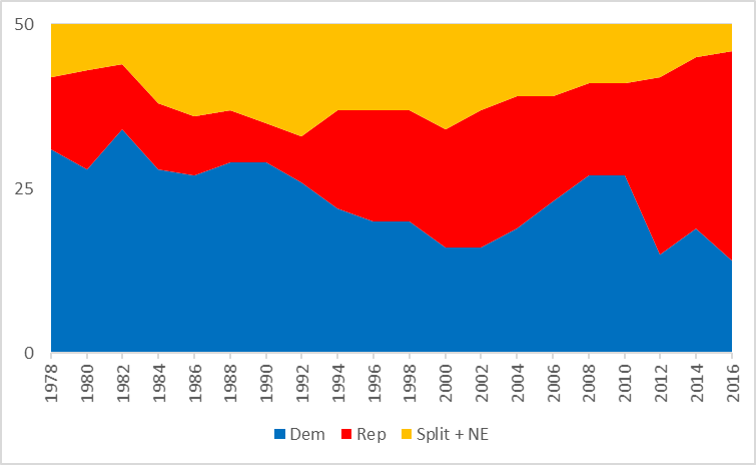
In the short term this is seen as a boon to Republicans who currently control 28 of the 50 state legislatures (18 are Democratic, and four are split).[20] State legislatures generally have the power of gerrymander. This may very well come back to bite them. Over the past fifty years, the Republicans have only rarely controlled half of the states.[21] There is every chance that, as a Trump-defined party veers further from the mainstream, the Democrats will take back the upper hand, and will take their example from California Governor Newsom, who responded to Republican gerrymandering in Texas by doing the same for the Democrats in his state.[22]
Over my career, for more than four decades, I have never felt that the majority of the Court was on the side of my clients. There are some areas where the Court is patently driven by its antipathy towards abortion or affirmative action, and they are clearly just sick and tired of being required to review and vote on emergency stay applications in as many as one capital case every week, year-in, year-out.[23] Yet the five cases where I have helped secure certiorari review have all come out in favour of my client, generally a despised death row prisoner or a still more hated Guantánamo “terrorist”.[24] I see this less as a comment on my advocacy than the fact that most justices genuinely do view their task as being to respect and enforce the U.S. Constitution. As the debacle of the Trump Presidency ploughs on, thus far my view remains unchanged.
Because something similar looms on the horizon in Britain, with the very real possibility of a Reform government led by Nigel Farage, one has to consider whether the same will be true in the U.K., where we have comparatively little by way of a legal bulwark against populist extremism.
© Professor Clive Stafford Smith JD OBE 2026
Footnotes
[1] Trump v. United States, 603 U.S. ___ (2024).
[2] There are plenty of decisions to come in the last month and a half. The most contentious is probably the birthright citizenship case, where Trump is trying to take away the right of those born in the U.S. essentially automatically to hold citizenship. See Trump v. Barbara, 607 U.S. ___ (2025) (certiorari before judgment granted). I suspect the Court will uphold the right in another blow to Trump, and refuse to overturn United States v. Wong Kim Ark, 169 U.S. 649 (1898), the case that buried the dreadful decision of Dred Scot v. Sandford, 60 U.S. 393 (1857). In Dred Scot, the Court had held, 7-2, that children of slaves were not citizens. The case inflamed passions among those pro- and anti-slavery, and is thought to have been a significant factor in the march towards Civil War just four years later.
[3] There is only one case where the liberals prevailed, and Chief Justice Roberts was not in the majority, and in that case the second most senior justice (Thomas) assigned it to himself. Hencely v. Fluor Corp. No. 24-924 (Thomas 6-3) (dissent by Alito, Roberts & Kavanaugh) (US military officer injured by Taliban operative hired by Fluor allowed to sue).
[4] M & K Employee Solutions, Inc. v. Trustees of IAM Nat. Pension No. 23-1209 (Jackson 9-0) (unanimous); Montgomery v. Caribe Transport II, LLC No. 24-1238 (Amy Coney Barrett 9-0) (unanimous) (car wreck case); Jules v. Andre Balazs Properties No. 25-83 (Sotomayor 9-0) (unanimous); First Choice Women’s Resource Centers, Inc. v. Davenport No. 24-781 (Gorsuch 9-0) (unanimous) (win for religious nonprofit organization that has provided counseling and resources to pregnant women in New Jersey since 1985; believing that life begins at conception, the group does not provide abortions or refer clients to others for abortions) (First Amendment case); Enbridge Energy, LP v. Nessel No. 24-783 (Sotomayor 9-0) (unanimous)(loss for energy company on technical grounds); Chevron USA Inc. v. Plaquemines Parish No. 24-813 (Thomas 8-0) (unanimous) (win for oil company on removal issue); Cox Communications, Inc. v. Sony Music Entertainment No. 24-171 (Thomas unanimous, with concurrence by Sotomayor & Jackson on copyright secondary liability); Olivier v. City of Brandon No. 24-993 (Kagan 9-0) (unanimous) (sidewalk preacher allowed to sue for prospective First Amendment relief over local ordinance; Heck no bar even though he had previously been convicted of misdemeanor violation); Urias-Orellana v. Bondi No. 24-777 (Jackson 9-0) (unanimous; bad asylum case – aren’t they all going to back to Stevic v. INS? – requiring substantial evidence petitioner would be killed by hitman); Galette v. New Jersey Transit Corp. No. 24-1021 (Sotomayor 9-0) (unanimous) (No immunity for NJ Transit); Villarreal v. Texas No. 24-557 (Jackson 9-0) (unanimous with concurrences) (Texas could forbid counsel from talking to the client about his testimony but not about anything else) (Alito, Gorsuch and Thomas would rather go back to when the defendant could not testify at all); Geo Group, Inc. v. Menocal No. 24-758 (Kagan, 9-0) (unanimous with concurrences) (Thomas & Alito would go further) (No interlocutory appeal for contractor as they have a defense to liability not immunity); Hain Celestial Group, Inc. v. Palmquist No. 24-724 (Sotomayor for 9-0) (unanimous) (on dismissal of toxic baby food case which should be in state court); Berk v. Choy No. 24-440 (Amy Coney Barrett 9-0) (unanimous with Jackson concurrence) (Delaware requirement that a physician attest to validity of malpractice suit does not apply in federal court); Ellingburg v. United States No. 24-482 (Kavanaugh 9-0) (victim payment statute was penal and therefore ex post facto as applied in this case) (Thomas concurrence joins in full); Coney Island Auto Parts Unlimited, Inc. v. Burton No. 24-808 (Alito 9-0) (unanimous though Sotomayor concurs) (time limit on challenge to void judgment); Barrett v. United States No. 24-5774 (Jackson 9-0) (unanimous though Gorsuch concurrence posing the double jeopardy issue; Congress did not authorize two convictions for same conduct); Case v. Montana No. 24-6424 (Kagan 9-0) (unanimous though Sotomayor and Gorsuch concur) (Fourth Amendment reasonable cause from emergency situation); Doe v. Dynamic Physical Therapy, LLC No. 25-180 (per curiam) (unanimous) (State of Louisiana cannot immunize healthcare workers from federal litigation); Clark v. Sweeney No. 25-52 (per curiam) (unanimous reversal of 4th Circuit which granted relief on issues not presented where juror had visited the scene); Pitts v. Mississippi No. 24-1159 (per curiam) (unanimous reversal of Mississippi application of child shield law as violation of confrontation clause violation).
[5] Klein v. Martin No. 25-51 (per curiam) (8-1 decision where Brady issue was not decided clearly erroneously by state court; Jackson would deny certiorari); Rico v. United States No. 24-1056 (Gorsuch 8-1 in favour of the criminal defendant on application of sentencing factor, Alito dissenting); Chiles v. Salazar No. 24-813 (Gorsuch 8-1) (interesting “conversion therapy” ban case where the therapist wins on first amendment grounds, on the reasonable principle that the only answer to a bad idea is a better idea; Jackson dissented saying it is just regulating medicine); Havana Docks Corp. v. Royal Caribbean Cruises, Ltd. No. 24-983 (Thomas, 8-1) (Sotomayor & Kavanaugh concurring; Kagan dissenting on old time Cuban property trafficking case); cf. District of Columbia v. R.W. No. 25-248 (per curiam) (Fourth Amendment issue reversed 8-1 but Sotomayor would only have denied review).
[6] Zorn v. Linton No. 25-297 (per curiam) (6-3 in favour of police officer immunity in violence against a protester, liberals dissent); Louisiana v. Callais No. 24-109 (Alito 6-3; liberals dissenting) (a foolish decision that the Republicans may come to regret, that presupposes no affirmative action is really consistent with the Bill of Rights).
[7] Hencely v. Fluor Corp. No. 24-924 (Thomas 6-3) (dissent by Alito, Roberts & Kavanaugh) (US military officer injured by Taliban operative hired by Fluor allowed to sue); Learning Resources, Inc. v. Trump No. 24-1287 (Roberts, 6-3) (Tariffs case where Thomas, Kavanaugh & Alito dissent); Mirabelli v. Bonta No. 25-A810 (per curiam) (6-3, religious exemptions from California law saying child’s definition of gender is dispositive granted as to parents not others) (Kagan & Jackson dissenting; Sotomayor would just deny it; Thomas & Alito would grant it for all).
[8] Postal Service v. Konan No. 24-351 (Thomas, 5-4) (US sovereign immunity on delivery of mail, even where it was withheld for racist reasons) (Sotomayor, Kagan, Jackson & Gorsuch dissent).
[9] Learning Resources, Inc. v. Trump No. 24-1287 (Roberts, 6-3) (Tariffs case where Thomas, Kavanaugh & Alito dissent.
[10] See https://www.theguardian.com/us-news/2026/apr/20/trump-tariffs-refund-claims.
[11] See https://deathpenaltyinfo.org/death-row/overview.
[12] Hamm v. Smith No. 24-872 (per curiam dismissing grant of certiorari, 7-2) upholding relief for a death row prisoner, with Thomas and Alito dissenting. Later opinions made the final ruling 5-4 but Hamm still won.
[13] First Choice Women’s Resource Centers, Inc. v. Davenport No. 24-781 (Gorsuch 9-0) (unanimous) (win for religious nonprofit organization that has provided counseling and resources to pregnant women in New Jersey since 1985; believing that life begins at conception, the group does not provide abortions or refer clients to others for abortions); Mirabelli v. Bonta No. 25-A810 (per curiam) (6-3, religious exemptions from California law saying child’s definition of gender is dispositive granted as to parents not others) (Kagan & Jackson dissenting; Sotomayor would just deny it; Thomas & Alito would grant it for all); Chiles v. Salazar No. 24-813 (Gorsuch 8-1) (interesting “conversion therapy” ban case where the therapist wins on first amendment grounds; Jackson dissents as she views it is as just regulating medicine); Olivier v. City of Brandon No. 24-993 (Kagan 9-0) (unanimous) (sidewalk preacher allowed to sue for prospective First Amendment relief over local ordinance; Heck no bar even though he had previously been convicted of misdemeanor violation).
[14] See District of Columbia v. R.W. No. 25-248 (per curiam) (Fourth Amendment issue reversed 8-1 but Sotomayor would only have denied review); Case v. Montana No. 24-6424 (Kagan 9-0) (unanimous though Sotomayor and Gorsuch concur) (Fourth Amendment reasonable cause from emergency situation); see also Villarreal v. Texas No. 24-557 (Jackson 9-0) (unanimous with concurrences) (Texas could forbid counsel from talking to the client about his testimony but not about anything else; Alito, Gorsuch and Thomas would rather go back to when the defendant could not testify at all); Klein v. Martin No. 25-51 (per curiam) (8-1 decision where Brady issue was not decided clearly erroneously by state court; Jackson would deny certiorari); Clark v. Sweeney No. 25-52 (per curiam) (unanimous reversal of 4th Circuit which granted relief on issues not presented where juror had visited the scene).
[15] Hamm v. Smith No. 24-872 (per curiam dismissing grant of certiorari, 7-2, upholding relief for a death row prisoner, with Thomas and Alito dissenting); Ellingburg v. United States No. 24-482 (Kavanaugh 9-0) (victim payment statute was penal and therefore ex post facto as applied in this case); Barrett v. United States No. 24-5774 (Jackson 9-0) (unanimous though Gorsuch concurrence posing the double jeopardy issue; Congress did not authorize two convictions for same conduct); Bowe v. United States No. 24-5438 (Sotomayor 5-4) (successive petition on crime of violence in sentencing reversal; liberals and Roberts, Kavanaugh hold that a cert petition is available and that prior litigation of the same issue is not a bar in §2255 as it would be in §2254); Pitts v. Mississippi No. 24-1159 (per curiam) (unanimous reversal of Mississippi application of child shield law as violation of confrontation clause violation).
[16] Michael O’Donnell, Commander v. Chief: the lessons of Eisenhower’s Civil Rights struggle with his Chief Justice Earl Warren, The Atlantic (April 2018), available at https://www.theatlantic.com/magazine/archive/2018/04/commander-v-chief/554045/.
[17] Urias-Orellana v. Bondi No. 24-777.
[18] Noem v. Abrego Garcia, 604 U.S. ___ (2025).
[19] Zorn v. Linton No. 25-297 (per curiam) (6-3 in favour of police officer immunity in violence against a protester, liberals dissent); Louisiana v. Callais No. 24-109 (Alito 6-3; liberals dissenting) (a foolish decision that the Republicans may come to regret, that presupposes no affirmative action is really consistent with the Bill of Rights).
[20] See https://www.multistate.us/resources/2026-state-legislatures.
[21] See https://web.education.wisc.edu/nwhillman/wp-content/uploads/sites/16/2017/02/ncsl_1978-2016.png.
[22] See https://www.theguardian.com/us-news/2025/aug/21/california-legislature-redistricting-plan.
[23] Of course if one is going to lay the blame for this disturbing the justices’ sleep anywhere, it should be on the states that seek, pointlessly, to execute people.
[24] Johnson v. Mississippi, 108 S. Ct. 1981 (1988) (unanimous reversal of death sentence for improper consideration of invalid prior conviction, secured life on resentencing); Shell v. Mississippi, 111 S. Ct. 313 (1990) (unanimous reversal of death sentence for invalid consideration of aggravating circumstance, secured plea to life on resentencing); Minnick v. Mississippi, 112 L. Ed. 2d 489 (1990) (reversal of conviction for violation of the Fifth Amendment right to counsel, secured plea to life on retrial); Lonchar v. Thomas, 116 S. Ct. 1293 (1996) (certiorari granted 58 seconds before petitioner's scheduled execution, resulting in unanimous decision in favor of the death sentenced inmate); one of the counsel involved in the litigation of Rasul v. Bush, 542 U.S. 466 (2004) (availability of judicial review for prisoners in Guantánamo Bay).
Part of:
This event was on Thu, 04 Jun 2026

Support Gresham
Gresham College has offered an outstanding education to the public free of charge for over 400 years. Today, Gresham College plays an important role in fostering a love of learning and a greater understanding of ourselves and the world around us. Your donation will help to widen our reach and to broaden our audience, allowing more people to benefit from a high-quality education from some of the brightest minds.