
 Login
Login

Music of the Body
Share

- Details
- Text
- Audio
- Downloads
- Extra Reading
Music and biology are profoundly entwined. The heart beats, footsteps fall into familiar tempi, and even the movement of our limbs follows a natural rhythmic hierarchy—as if we shape music in our image. The rise and fall of breath, the cadence of laughter, and the wail of a cry all carry musical gestures, woven into our being. Yet our bodies do not just dictate music—they respond to it, from calming stress to thrilling chills. Beyond this, the biological world itself pulses with music: DNA sequences become melody, disease growth swells into an orchestral crescendo, and a hidden music emerges from within us.
Download Text

Music of the Body
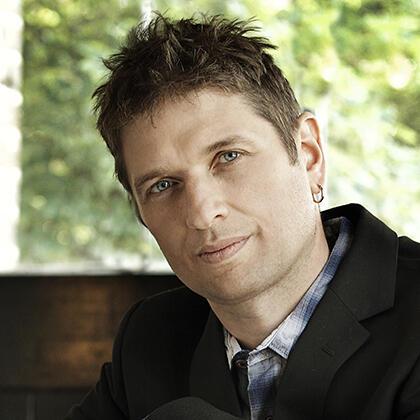
Professor Milton Mermikides
A Life in Music
“The shortest distance between two humans is music" M.M.(2026)
Our lives begin bathed in sound. We are enveloped in the throbbing oscillations of the womb;, the sustained texture of blood flow, the cadences of digestion, and the cross-rhythm of our mother’s heartbeat with our own. In case you are wondering this is likely around a 3 against 2 rhythm (the ‘perfect 5th’ of rhythm). We are also aware of external sounds – including music – and studies suggest that prenatal exposure to music has lasting effects. Babies remember music they have heard in the womb for months after birth. The sonic connection to the mother continues with the mother’s song and the melodic contours of infant directed speech and song, maintaining a strong maternal connection post birth and acting as an ‘acoustic umbilical cord’. Our experience of music is inescapable from our bodies, and this lecture examined how our bodies shape the music we make, and even if they contain a music of their own. This idea is not new: the Ancient Roman philosopher Boethius spoke of three types of music: Musica Instrumentalis - audible music produced by voice and instruments; Musica Mundana – the ‘music of the spheres’ discussed in lecture 3 of this series ‘The Music of Earth & Space’, and Musica Humana – the internal music of the body. So what this Music Humana could actually be, is explored here.
Breathe
Humans – instigated to some degree by our pedalism – have an unusual vocalisation system with significantly dropped larynxes, and highly sophisticated control of our vocal folds, mouth shape, lips, tongue and soft palates. This system is costly and introduces a significant choking hazard; however it gives humans a staggering range of vocal production – and the extraordinary power of speech – which cultures exploit in order to communicate. The constituent speech fragments – phonemes – vary across the world - some universal, some unique to just a small number of languages. Vocal music has both adopted and expanded this library of phonemes for expressive purposes. Figure 1 shows MRI images of a vocalist singing the same pitch and vowel sound sung in four different styles, with significantly different mouth shapes.
Infused into musical structure is human breath. Research in music cognition shows that listeners infer phrase boundaries from cues such as pauses and durational lengthening, which function analogously to breathing in speech (Knösche, 2005; Nan et al., 2006). Within an embodied cognition framework, such structures are understood as grounded in bodily constraints, including respiration (Leman, 2007). Empirical studies further demonstrate that performers’ breathing patterns are closely coupled to musical phrasing, even in instrumental contexts (Cara et al., 2024).
Figure 1: An illustration of the same note (B♭4) and vowel sound (/ɛ/) sung in 4 different vocal styles. (@tyleyross) [See downloadble document]
What is remarkable about musical expression is that it not only mimics controlled human speech, but also those times when we lose control of our speech. When crying and sobbing, we are unable to speak clearly and take short gasps before exhalations of noisy non-linear spectra. This is mirrored in – for example – the opening of Elgar’s Cello Concerto with short breaths notated (or technically obliged) between deeply bowed harmonically rich grief-stricken notes and chords.
We also lose control – and even the ability to breathe – when laughing. When struggling to contain our laughter we lose control of our vocal folds, resulting in a wayward and generally rising pitch contours with occasional squeaks. Elgar again mimics this in Variation X of the Enigma Variations, an homage to his dear friend ‘Dorabella’ playfully translating her stuttering infectious laughter into bursts of high trills in the woodwinds.
How the Ear Creates Scales and Harmony
So music – even when performed on instruments alone – seems to be deeply influenced by human breath and speech. But what of pitches themselves, where do the notes of the scales used in music come from? Again it is the body – and specifically the spatial mapping of frequency along the ear cochlea – that provides a physiological basis for musical material and our experience of it. Different frequencies stimulate different regions of the basilar membrane, arranged from low to high, but each region responds not to a single frequency, rather to a small range known as a critical band. It is within this slightly blurred spatial encoding that dissonance begins to emerge. With pure sine waves, the situation is relatively simple. Two sine tones produce strong sensory dissonance only when they fall within the same critical band. In this case, their excitation patterns overlap, creating interference in neural firing that we perceive as beating or roughness. As the tones move further apart, the overlap diminishes and the roughness disappears. In other words, for simple tones, dissonance is largely a local phenomenon, confined to close frequency proximity (see Figure 2 top left).
The richer and more musically relevant picture arises when we consider real instrumental sounds. Most musical tones are complex, containing many overtones. When two such tones are played together, the ear is not comparing two frequencies but a network of interacting partials. Each overtone from one note may fall within, near, or outside the critical bands of overtones from the other. It is this dense web of interactions that generates the familiar pattern of peaks and troughs in dissonance across intervals. With ‘harmonic intervals’ produced by a saw-tooth and akin to a violin tone, the minima observed in the classic two-dimensional dissonance curve – corresponding to intervals such as the octave (2:1), fifth (3:2), and fourth (4:3) – arise because these ratios align many partials or space them in ways that avoid critical-band interference. By contrast, more complex ratios produce greater overlap between partials, increasing roughness. The apparent stability of consonant intervals is therefore not arbitrary, but emerges from how harmonic spectra are distributed across the tonotopic structure of the ear.
However, this landscape is not fixed. Different instruments have radically different overtone profiles, and these reshape the terrain of dissonance.Inharmonic sources such as bells or certain electronic timbres can transform the landscape entirely, shifting or even dissolving the familiar minima, hence the diversity of tuning systems in gamelan, steel-pan and other timbrally-informed styles. What counts as consonant or dissonant is therefore contingent on the spectral makeup of the sound. The familiar two-dimensional curve represents the dissonance between two tones. But harmony in music often involves three or more notes. When we move to harmony - say three notes at once, the system expands into three dimensions. Each pairwise interaction contributes to the overall roughness, producing a complex surface of peaks, valleys, ridges and basins. This creates a genuinely spatial model of harmony: a navigable topography in which chords occupy regions rather than points, and movement through harmony becomes a trajectory across a multidimensional dissonance landscape.
It is essential to recognise that this is a description of possibility, not a prescription for musical practice. Tonotopology gives us the terrain, but not the route. Western tonal traditions have historically favoured pathways that move between areas of relative smoothness, but this is one cultural strategy among many. Other traditions and contemporary practices explore very different regions of the landscape, including those rich in roughness and instability. Equally, dissonance is not inherently negative. The interference patterns that generate roughness also create energy, tension and expressive potential. Dissonance can imply motion, urgency, fragility or intensity, and often gains its meaning through contrast with more stable regions. A completely smooth landscape would offer little sense of direction or transformation.
Recent developments in microtonal music highlight how adaptable our perception is. The unprecedented success of the microtonal duo Angine de Poitrine shows how quickly listeners can acclimatise to unfamiliar interval systems. What initially appears dissonant can become coherent and expressive with exposure. Listeners begin to recognise new points of stability and new pathways across the terrain, effectively learning a different musical geography. In this way, tonotopy anchors our experience of dissonance in the physical behaviour of the ear, while the overtone structures of instruments and the practices of cultures shape how that experience unfolds. The landscape is real and measurable, but it is not limiting. Music does not obey it so much as explore it, continually finding new ways to move through, reshape and reimagine the terrain of sound.
Figure 2: How the tonotopical sensitivity of the brain creates dissonant profiles. Two sine waves played together sound consonant (“smooth”) when similar, however at a close proximity create a rough dissonance which slowly diminishes at wider intervals (top left). The resulting dissonant profile of two saw tooth waves forms a profile dipping at simple ratios such as the major third (5/4), perfect fourth (4/3), perfect 5th (3/2) and octave (2/1) (top right). When three saw tooth waves are combined they form a complex dissonance surface with dips at familiar triadic structures. (Images from https://aatishb.com/dissonance/) [See downloadble document]
The Rhythm of Bodily Movement
Figure 3: How heart rates map onto musical tempi [See downloadble document]
Sound and movement are closely linked in our evolution as a species, as well as in our development from child to adult. Every breath, movement and step is accompanied by sound, and we use this link to refine our physical connection to the world. Hearing allows us to anticipate, respond, and coordinate, linking movement in space with movement in time. It is therefore natural to understand music as motion through time. Even without a spatial component, music can feel static, gradual, or urgent, reflecting this deep connection between temporal flow and bodily experience. This relationship is echoed in the time scales and language of music. A traditional metronome range of roughly 40 to 200 beats per minute closely mirrors human heart rates, from rest to stress. Within this range also sit the tempos of walking and running, from a leisurely 60 bpm to faster, more energetic movement. A walk through the world becomes, through sound, a walk through time. At smaller scales, our perception aligns with bodily function: reaction times and speech decoding operate in the 10–200 ms range, while our ability to hold rhythmic groupings extends to around half a minute, reflecting short-term memory limits. Our temporal experience of sound appears calibrated to our physical engagement with the world.
This coupling of sound and movement also enables social cohesion. Rhythmic coordination underpins dance, play, and labour, allowing groups to align their actions efficiently. Across cultures, music often emerges directly from such activities. Among the Bayaka, children engage in liquindi, or water drumming, transforming bathing into a complex, playful musical interaction that builds skill and social bonds. In more arduous contexts, work songs such as ‘Rosie’, recorded by Alan Lomax in 1948, coordinated the movements of prison labourers through call-and-response singing. Similarly, sea shanties structured collective effort through rhythm and leadership. In each case, music functions not only as coordination but as a means of sustaining morale and unity.
Even when detached from these original functions, the sense of movement persists in music. Performers align with remarkable precision, and listeners often exhibit physiological synchrony, such as matched breathing or heart rates. The boundaries between music as coordination, communication, and pleasure are therefore fluid. Through rhythm’s choreography in time, music continues to connect bodily motion, social interaction, and expressive experience.
Hand to Heart
Human understanding of music has always been entangled with the human body providing models for rhythm, proportion, gesture, expression, and even musical memory itself. One of the clearest historical examples is the Guidonian Hand, developed in the medieval period as a pedagogical tool associated with Guido d’Arezzo. In this remarkable system, different notes of the hexachord were mapped onto the joints and fingertips of the hand. A teacher could point to sections of the hand to indicate pitches, allowing singers to internalise complex chant structures before widespread literacy or printed scores. The hand became both mnemonic device and embodied map of musical space. Music theory was literally held in the palm of the hand. Rhythm too often emerges from bodily experience. The flamenco Siguiriyas rhythm, commonly rendered as short-short-long-long-short, is memorised by the relative length of fingers (see Figure 4)
The heart has also served as both metaphor and material for musical creation. The asymmetric beat pattern of the heart is echoed in such pulses as the Tango tresillo. Other translations are more abstracted: In the late medieval period, the composer Baude Cordier famously notated pieces in the shape of a heart, merging musical structure with bodily symbolism. Contemporary composers have gone further still, directly translating heartbeat data into musical scores or electronic processes. In these works, physiology becomes composition. The body is not simply represented in music; it generates it.
At the same time, the physical limits of the body profoundly shape musical possibility. Human reaction time, breath capacity, tendon structure, and neural processing all define what can be performed and perceived. Yet music also pushes those limits outward in extraordinary ways. Musicians train the body into states of astonishing sensitivity, dexterity, and precision. Consider the opening of Pablo de Sarasate’s Zigeunerweisen (Gypsy Airs), which reaches a G7 on the violin’s top string. At such extreme registers, the physical distance between notes becomes minuscule. The gap between G7 and G♯7 is roughly 2mm. To perform this accurately within even a 5% margin requires control within a space thinner than paper. Musical virtuosity therefore reveals something extraordinary about the nervous system: the body can be trained to execute actions at almost microscopic levels of precision. The timing control and sensitivity of musicians is routinely and comfortably below the 50ms range. For context, a blink of an eye takes over 100ms.
Yet music is not shaped only by idealised or “perfect” bodies. Some of the most distinctive musical languages emerge precisely through bodily difference and limitation. Django Reinhardt, after suffering severe burns to his hand as a child, was left able to fret largely with only two fingers. Rather than ending his career, this limitation reshaped his entire musical vocabulary. His solos developed unique patterns of movement, intervallic shapes, and sweeping gestures born directly from the physical realities of his injured hand. Today, many Gypsy jazz guitarists learn his solos using only two fingers as a rite of passage, honouring both the technique and the astonishing creativity behind it. The extraordinary visually impaired blues guitarist Jeff Healey, in order to orient himself to the fretboard played it ‘over hand’ with his hands in typewriter positions, affording a staggering fluency and bending technique. Technology has widened access to musical expression. Take the guitar prodigy Jason Becker, whose extraordinary performing career was stifled by a development of ALS and his ultimate extensive paralysis, continues to compose (using eye movement controlled software) and produce colourful, sophisticated and inventive music.
Music therefore reveals a circularity between body and art. While the body shapes music, music also reshapes the body. Through listening, repetition, and performance, humans develop heightened perception, refined motor control, and new expressive possibilities. Far from transcending the body, music continually reminds us that creativity emerges through it. The extraordinary abundance of musical invention lies not despite human physicality, but because of it.
Figure 4: Left: The 15th-Century Guidonean Hand (Bodleian Library), an early music system for teaching, communicating and understanding melody using patterns of finger joints. Right: 15th-Century composer Baude Cordier’s heart-shaped score for Belle, Bonne, Sage. [See downloadble document]
Heal Me: The Promise of Music Therapy
Music therapy is best understood as a structured clinical use of music, usually delivered by a trained therapist, rather than the broader and vaguer claim that “music is good for you.” The strongest findings in the current literature are cautious but meaningful: music-based interventions can reduce anxiety, depressive symptoms, distress, pain, fatigue, and agitation, while improving aspects of quality of life, especially in situations where illness, disability, trauma, or institutional care limit normal communication and emotional expression. In dementia care, systematic reviews suggest that music therapy probably improves mood and may reduce behavioural symptoms such as agitation and social withdrawal. However, the evidence for substantial improvements in memory or general cognition remain more limited. Similarly, in cancer care and palliative medicine, music interventions are associated with reductions in anxiety, pain perception, and emotional distress, but these should be understood as supportive rather than curative effects. Across psychiatry more broadly, meta-analyses indicate encouraging outcomes for depression and anxiety disorders, though effect sizes vary considerably depending on the patient group, therapeutic method, duration of treatment, and study quality.
The most defensible contemporary claim is therefore not that music therapy changes disease prognosis in a direct medical sense, but that it can significantly improve the lived experience of illness. Benefits are most consistently found in emotional regulation, social connection, stress reduction, subjective well-being, and patient engagement. Music can offer non-verbal forms of expression and agency that are particularly valuable where language fails or where emotional states are difficult to articulate directly. In short, it’s unclear if music makes us live longer, but it seems to make music more worth living.
At the same time, many important questions remain unresolved. Methodological challenges are substantial: many studies are small, difficult to blind, and highly heterogeneous in design. Music therapy itself encompasses a wide range of practices, from receptive listening to active improvisation, making comparison difficult. As a result, most major health organisations describe music therapy as a promising adjunctive intervention rather than a stand-alone treatment.
This context makes the mental health profile of professional musicians especially intriguing. If music can reduce distress and improve well-being, why are musicians themselves disproportionately affected by anxiety, depression, burnout, substance misuse, and other mental health challenges? Some explanations are relatively straightforward: precarious employment, irregular schedules, public scrutiny, financial instability, injury, hyper–competition, and identity-based perfectionism all contribute significantly. Studies of professional music workers consistently show elevated levels of psychological distress compared with the general population. Yet these occupational explanations may not fully account for the phenomenon. A plausible hypothesis is that people with heightened emotional sensitivity, rumination, or psychological vulnerability may be disproportionately drawn to music in the first place because it functions as a form of self-regulation, a refuge. Music offers structure, catharsis, emotional externalisation, social connection, and symbolic meaning. In this interpretation, music is not the cause of mental distress, but one of the ways sensitive individuals attempt to manage or transform it.
Music of the Body
“Suppose, for instance, one played a trick on this needle and caused it toretrace a path not made by the graphic translation of a sound, but self-sufficing and existing in nature– good, let us say it boldly, if it were (e.g.) eventhe coronal suture– what would happen? A sound must come into being,a sequence of sounds, music. . . Feelings of what sort? Incredulity, awe, fear,reverence yes, which of all these feelings prevents me from proposing a namefor the primal sound that would then come to birth?” (Rilke, 1919:1087)
In 1919 the poet Rainer Maria Rilke wrote a short and remarkable essay called Primal Sound (Ur-Geräusch). In it, he describes a thought experiment inspired by the early phonograph. Looking at the coronal suture of the human skull – the jagged seam running across the cranium – Rilke noticed its resemblance to the groove carved by a phonograph needle into a wax cylinder. He then proposed an extraordinary question: what if one could place a needle onto this naturally occurring pattern and “play” it as though it were a recording? What hidden sound, what latent music, might emerge from the body itself?
Rilke’s essay sits somewhere between poetry, philosophy, and speculative science. He was not seriously proposing a practical experiment so much as expressing a profound intuition: that nature itself may already contain hidden musical inscriptions waiting to be revealed. The world, in this view, is not silent matter but encoded vibration. Many decades later however, the text invited me to explore the idea practically, and make real Rilke’s thought experiment. The resulting work, Primal Sound (2004), began with a digital tracing of a human skull’s coronal suture. That contour was translated directly into sound data, creating a raw tearing sonic gesture, but this alone was too fragmentary to sustain a larger musical structure. Instead, I allowed the contour to shape multiple musical dimensions simultaneously. The suture became melody, harmony, timing, texture, and spatial movement. Loops in the contour triggered musical events; vertical position determined harmonic placement and stereo position; converging and diverging lines generated beating frequencies and evolving sonic textures. Installed alongside the skull of an unknown Victorian woman at the Royal College of Surgeons, the work created the uncanny impression that the body itself was somehow speaking or singing through its own structure. The experience transformed my understanding of composition. It suggested that music need not originate solely in conventional instruments or notation, and human pre-conception, but could emerge from hidden forms and processes already present in the world around us – and within us.
Around the same period, while undergoing treatment for leukaemia and a bone marrow transplant, I began another sonification project entitled Bloodlines. During months spent in hospital isolation, my blood was analysed daily for fourteen different cellular measures, including white blood cells, platelets, and red blood cells. Those fluctuating values became the basis for a musical composition in which each blood marker controlled a separate musical layer. The piece compresses time so that each day of treatment becomes one second of music. The dramatic collapse of white blood cell counts during chemotherapy becomes audible as a descending microtonal swell. What emerged was more than data converted into sound; it became a form of not just autobiographical but autobiological music written directly by the body’s changing condition and fight to survive.
Such direct translations of the biological world explore the same underlying idea: that hidden within physical structures and biological processes are forms of rhythm, contour, and organisation that can be rendered musically. Increasingly, biology itself seems to invite musical metaphor. DNA operates through repetition, recombination, mutation, and variation – processes strikingly similar to the transformation of musical motifs across a symphony. Tiny inherited fragments recur, combine, disappear, and return in altered forms across generations. In that sense, perhaps we are not merely listeners to music, but partly constituted by it: living accumulations of recurring patterns unfolding through time. Our identities, bodies, and histories may be understood as melodies gathered across countless recompositions within the musica humana - a vast unfolding symphony of life.
© Professor Milton Mermikides 2026
Acknowledgments
The Gresham Team for the wonderful continued support of these lectures.. Daniel Solomons for lending his brain activity to the musical cause. The NHS for getting me this far. Bridget and Chloe.
References and Further Reading
Ball, P. (2010). The music instinct: How music works and why we can’t do without it. Oxford University Press.
Cundy, A.M (2026) Multimodality and Wellbeing in Classical Violin Pedagogy. PhD Thesis. University of Surrey
Faria, R. & Antunes da Silva, M. (2016). Lowering dissonance by relating spectra on equal tempered scales.
Foster Vander Elst, O., Foster, N. H. D., Vuust, P., & Kringelbach, M. L. (2021). The neuroscience of dance: A systematic review of the present state of research and suggestions for future work.
Huron, D. (2006). Sweet anticipation: Music and the psychology of expectation. MIT Press.
Huss, M. (2024) ‘Unforgotten grooves: Reading and Listening to Rainer Maria Rilke’s Primal Sound’ in Groth S. K. & Frisk, H., eds (2024) Traces of Sound: Reflections of Sounds Unheard: 37–50. Lund: The Sound Environment Centre at Lund University.
Knösche, T. R. (2005). Perception of phrase structure in music. Annals of the New York Academy of Sciences, 1060(1), 275–280.
Leman, M. (2007). Embodied music cognition and mediation technology. MIT Press.
Mermikides, M. (2025) Hidden Music: The Composer’s Guide to Sonification. Cambridge University Press.
Nan, Y., Knösche, T. R., & Friederici, A. D. (2006). The perception of musical phrase structure: A cross-cultural ERP study. Brain Research, 1094(1), 179–191. https://doi.org/10.1016/j.brainres.2006.03.115
Partanen, E. (2013, October 30). Babies remember melodies heard in the womb, study suggests. The Guardian. https://www.theguardian.com/science/2013/oct/30/babies-remember-melodies-womb-study
Partanen, E., Kujala, T., Tervaniemi, M., & Huotilainen, M. (2013). Prenatal music exposure induces long-term neural effects. PloS one, 8(10), e78946.
Patel, A. D. (2008). Music, language, and the brain. Oxford University Press.
Portnova, G. V., Liaukovich, K., & Sharaev, M. (2025). The acoustic features of sincere joyful, sad, and fearful human non-verbal vocalizations and its effect on the emotional valence of cat's meowing. Cognitive neurodynamics, 19(1), 181. https://doi.org/10.1007/s11571-025-10370-7
Rilke, R. M. (2004). Primal sound (Ur-Geräusch). In: U. Fülleborn (Ed.), Werke: Kommentierte Ausgabe in vier Bänden(Vol. 4, pp. 1087–1089). Insel Verlag. (Original work published 1919)
Zaatar, M. T., Alhakim, K., Enayeh, M., & Tamer, R. (2023). The transformative power of music: Insights into neuroplasticity, health, and disease. Brain, Behavior, & Immunity - Health, 35, 100716.
Dissonance Tool: https://aatishb.com/dissonance/
Ball, P. (2010). The music instinct: How music works and why we can’t do without it. Oxford University Press.
Cundy, A.M (2026) Multimodality and Wellbeing in Classical Violin Pedagogy. PhD Thesis. University of Surrey
Faria, R. & Antunes da Silva, M. (2016). Lowering dissonance by relating spectra on equal tempered scales.
Foster Vander Elst, O., Foster, N. H. D., Vuust, P., & Kringelbach, M. L. (2021). The neuroscience of dance: A systematic review of the present state of research and suggestions for future work.
Huron, D. (2006). Sweet anticipation: Music and the psychology of expectation. MIT Press.
Huss, M. (2024) ‘Unforgotten grooves: Reading and Listening to Rainer Maria Rilke’s Primal Sound’ in Groth S. K. & Frisk, H., eds (2024) Traces of Sound: Reflections of Sounds Unheard: 37–50. Lund: The Sound Environment Centre at Lund University.
Knösche, T. R. (2005). Perception of phrase structure in music. Annals of the New York Academy of Sciences, 1060(1), 275–280.
Leman, M. (2007). Embodied music cognition and mediation technology. MIT Press.
Mermikides, M. (2025) Hidden Music: The Composer’s Guide to Sonification. Cambridge University Press.
Nan, Y., Knösche, T. R., & Friederici, A. D. (2006). The perception of musical phrase structure: A cross-cultural ERP study. Brain Research, 1094(1), 179–191. https://doi.org/10.1016/j.brainres.2006.03.115
Partanen, E. (2013, October 30). Babies remember melodies heard in the womb, study suggests. The Guardian. https://www.theguardian.com/science/2013/oct/30/babies-remember-melodies-womb-study
Partanen, E., Kujala, T., Tervaniemi, M., & Huotilainen, M. (2013). Prenatal music exposure induces long-term neural effects. PloS one, 8(10), e78946.
Patel, A. D. (2008). Music, language, and the brain. Oxford University Press.
Portnova, G. V., Liaukovich, K., & Sharaev, M. (2025). The acoustic features of sincere joyful, sad, and fearful human non-verbal vocalizations and its effect on the emotional valence of cat's meowing. Cognitive neurodynamics, 19(1), 181. https://doi.org/10.1007/s11571-025-10370-7
Rilke, R. M. (2004). Primal sound (Ur-Geräusch). In: U. Fülleborn (Ed.), Werke: Kommentierte Ausgabe in vier Bänden(Vol. 4, pp. 1087–1089). Insel Verlag. (Original work published 1919)
Zaatar, M. T., Alhakim, K., Enayeh, M., & Tamer, R. (2023). The transformative power of music: Insights into neuroplasticity, health, and disease. Brain, Behavior, & Immunity - Health, 35, 100716.
Dissonance Tool: https://aatishb.com/dissonance/
Part of:
This event was on Wed, 13 May 2026
Support Gresham
Gresham College has offered an outstanding education to the public free of charge for over 400 years. Today, Gresham College plays an important role in fostering a love of learning and a greater understanding of ourselves and the world around us. Your donation will help to widen our reach and to broaden our audience, allowing more people to benefit from a high-quality education from some of the brightest minds.