
 Login
Login

Lecture, Barnard's Inn Hall, Friday, 25 Sep 2026 - 11:00
Festival of Astronomical Ideas



 Need help registering?
Please note that this event is for in-person attendees only, we regret that there will be no live stream. Videos of each presentation will be uploaded in due course.
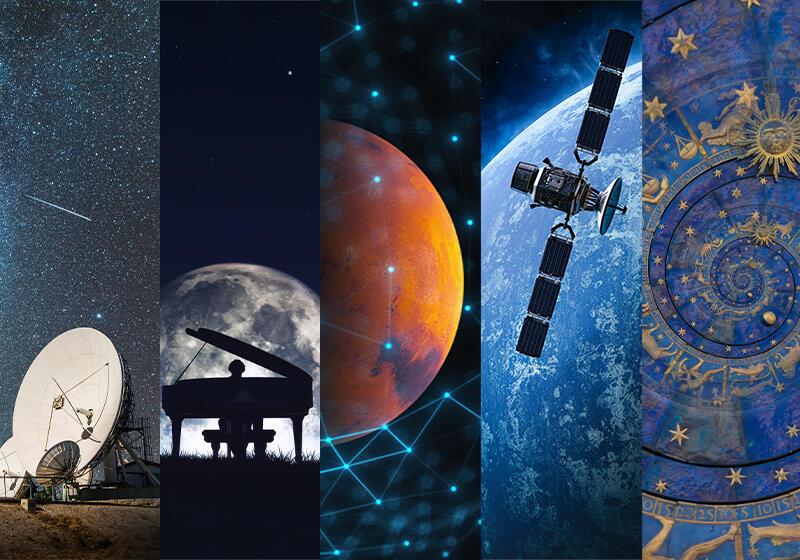
A one-day event featuring discussions, presentations, and performances that explore and celebrate the intersection of astronomy with other disciplines.
11am, Lift Off - Chris Lintott
This is a brief introduction to the topic, establishing the broad history of astronomical thought, astronomy’s long connections to other subjects, and Gresham’s own long history of engagement with the subject. A key aim will be to explain how we connect the many different ways of observing the sky with attempts to understand the nature of what is seen.
12 noon - Milton Mermikides: How to Play a Planet Space and Music II (Discussion and Performance)
Following on from last year’s lecture at the Festival of Musical Ideas, Professors Lintott and Mermikides will present, demonstrate and critique the idea of ‘astro sonification’, using sound and music to represent the astronomical patterns seen in the sky. A particular focus will be on representations of the diverse exoplanet systems now found around other stars, and on musical representations (historical and contemporary) of the worlds of our Solar System.
1pm, Ronald Hutton The Strange Story of Astroarcheology (Pre-recorded lecture, not in-person)
Of all the components of the environment around British prehistoric monuments, the sky is the one that has changed least across the millennia. This, and the fact that some of the most famous of these monuments were clearly aligned on heavenly bodies, should make the study of the relationship between those structures and celestial features a central concern to the archaeologists investigating them. Indeed, scholars have emerged for well over a century who have addressed that concern, but they have tended to come from outside the community of professional archaeology and to have had a fraught interaction with, or even an estrangement from, it. This lecture is designed to show why this is so, and why is it really a British phenomenon, and to ask whether things are likely to be different in the future.
2pm, Victoria Baines: Santa, Elon, and the Interplanetary Internet (Lecture and Discussion)
Unless it’s Christmas Eve, that chain of lights moving across the sky is probably not Santa’s sleigh but Starlink’s low earth orbit satellites (LEOs). To meet demand for ubiquitous, instantaneous, and uninterrupted communication, our internet infrastructure now extends into outer space. This talk explores who owns it, who has to clean up after it, and its impact on terrestrial politics. We’ll also take a look at how a new interplanetary internet might help shape the future of space exploration, to Mars and beyond.
3pm, Helen Czerski: What searching for life tells us about Earth (In conversation)
Professors Czerski and Lintott investigate how ocean Earth compares and differs from the other planets we’ve found, and how water worlds in many forms may be more common than expected. Using Lovelock’s framing of a biosphere, we consider life on these worlds and explain what this thinking about the Universe can tell us about our own planet.


Support Gresham
Gresham College has offered an outstanding education to the public free of charge for over 400 years. Today, Gresham College plays an important role in fostering a love of learning and a greater understanding of ourselves and the world around us. Your donation will help to widen our reach and to broaden our audience, allowing more people to benefit from a high-quality education from some of the brightest minds.